The most memorable champagne arrangements rely on contrast and restraint. A sculptural anthurium brings an editorial edge, while dusty miller and tall grasses give a coastal bouquet its loose, wind-swept character. Across all 15 ideas, the palette stays soft while the textures, silhouettes, ribbons, and settings create distinct personalities. The result is a floral style that feels romantic today and easy to love years from now.
1. Champagne Garden Heirloom
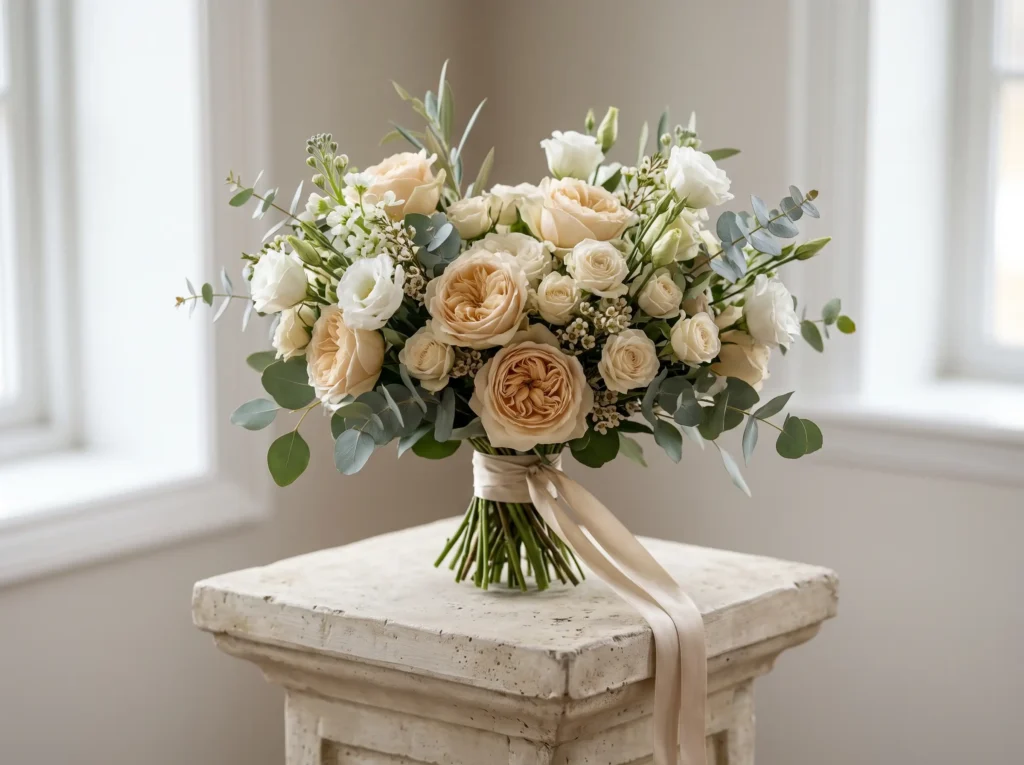
Soft blush. Warm cream. Quiet luxury. Layered garden roses anchor composition, their ruffled centers echoing peonies without peony’s fleeting bloom window. Lisianthus adds crisp white contrast, while eucalyptus trails soften edges, lending movement against structured stems below.
Weathered stone pedestal grounds arrangement in old-world elegance, hinting at estate gardens and heirloom lineage passed through generations. Champagne satin ribbon, wrapped stem to cascade, mirrors floral tones exactly. No jarring accents.
Just harmony. This pairing speaks to brides drawn toward timeless silhouettes over trend-driven florals. Texture does heavy lifting here—ruffled petals against smooth eucalyptus leaves, waxflower’s tiny buds scattered like punctuation. Elegant restraint, beautifully executed.
2. Champagne Vineyard Romance
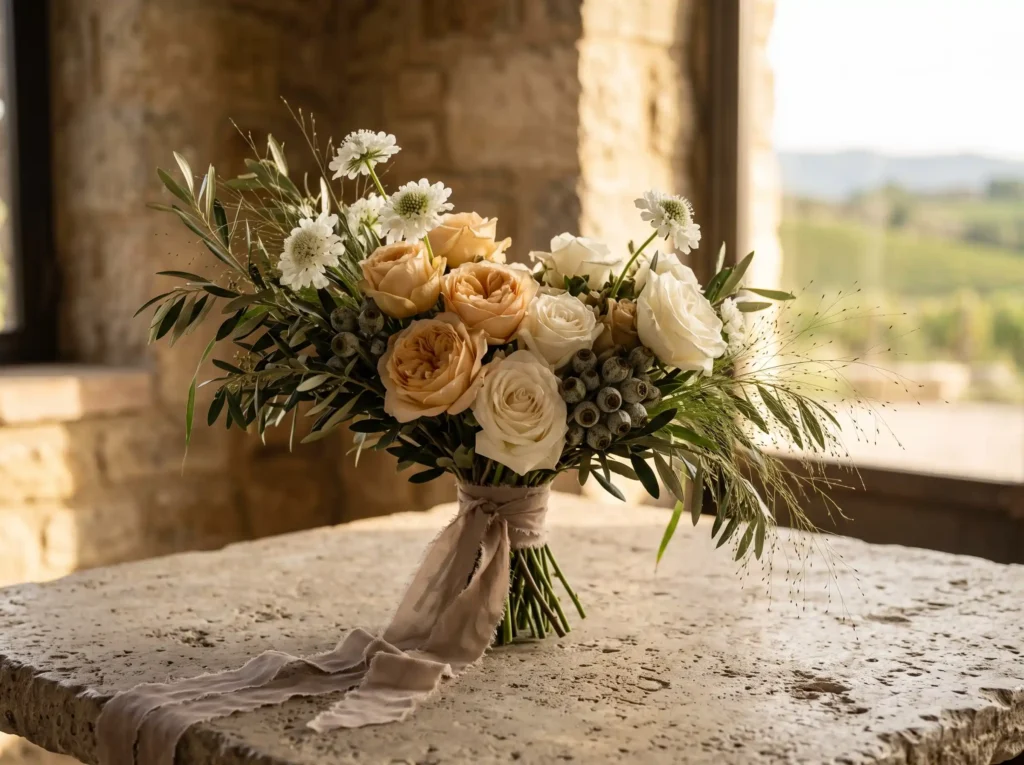
Sun-warmed stone. Rolling vines beyond glass. Setting alone tells story before flower is named. Peachy garden roses cluster against ivory counterparts, their layered petals catching golden hour light streaming through arched window. Olive branches weave through composition, nodding to Mediterranean wine country, while wispy grass plumes add textural whisper against structured blooms.
Scabiosa’s pincushion centers introduce delicate contrast, small white blossoms perched on slender stems like punctuation marks. Frayed silk ribbon, undone rather than polished, grounds arrangement in intentional imperfection—a favorite technique among florists chasing “just gathered” authenticity.
Landscape context matters here. Vineyard weddings lean into terroir, and bouquet answers that call directly.
3. Pearl-Toned Rose Cascade
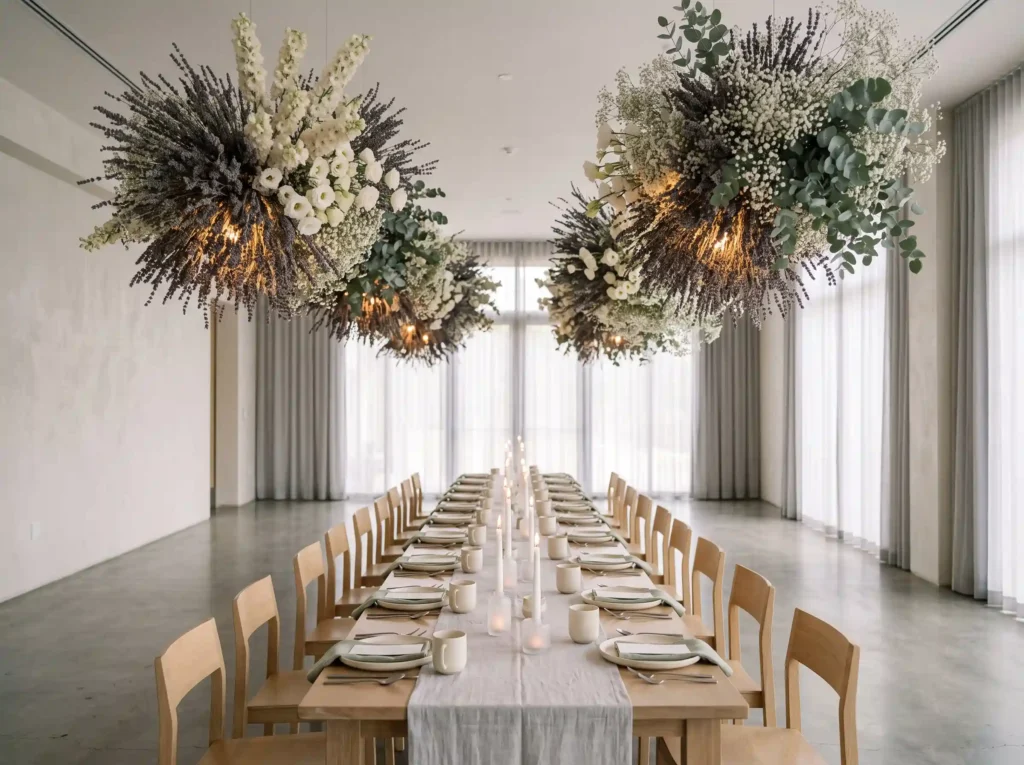
Florals leave ground entirely. Suspended orbs of lavender and white delphinium hover above long dining table, fairy lights woven through stems like captured starlight. Baby’s breath clusters mimic gathering clouds, eucalyptus trailing downward as if reaching toward guests below. Bold move, structurally speaking—installations require engineering most bouquets never demand.
Champagne palette shifts context here. Instead of bridal hand-tie, warm ivory tones anchor entire reception atmosphere, proving color story extends far beyond single arrangement. Minimalist wooden chairs and pale linens let florals command attention without competition.
Modern brides seeking drama without color saturation find blueprint worth studying. Height, light, and restraint working in concert.
4. Champagne Meadow Whispers
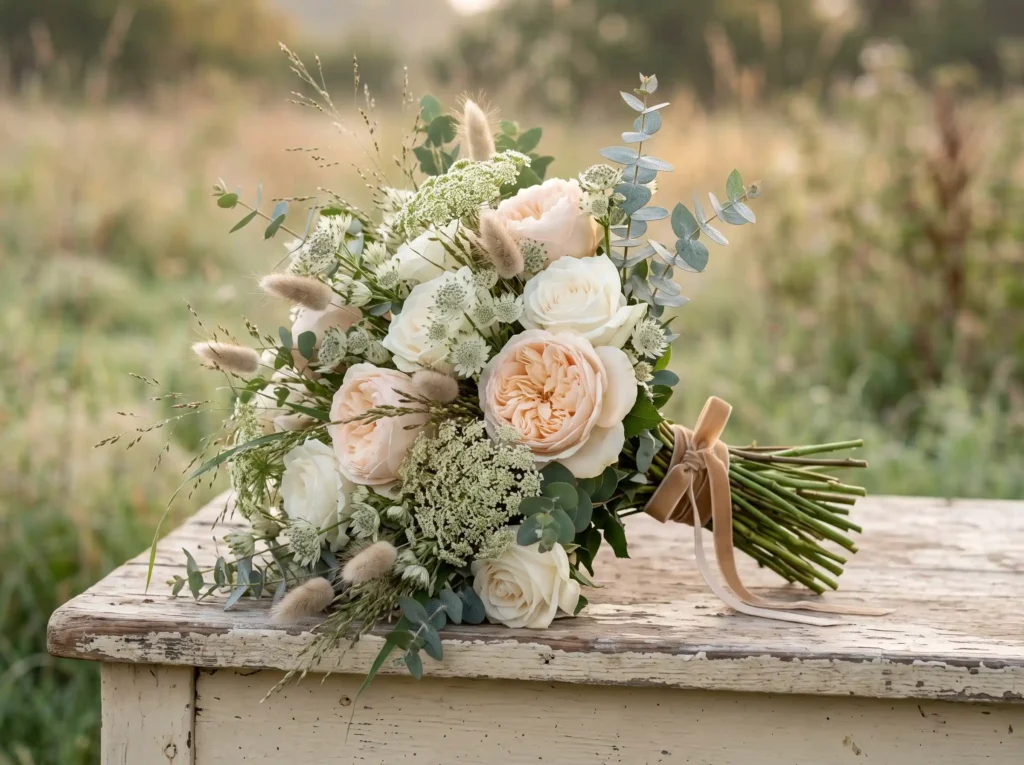
Bunny tail grass sways beside blush garden roses. Queen Anne’s lace scatters like lace doily torn loose, delicate umbels softening structured blooms beneath. Weathered paint peels from tabletop below, sun-drenched field stretching into soft-focus distance behind.
Foraged aesthetic reigns supreme. Nothing here feels arranged so much as discovered, gathered during golden-hour walk through unmown grass. Velvet ribbon, camel-toned and loosely knotted, completes rustic narrative without overdoing polish.
Texture drives this composition—fuzzy grass heads against silky rose petals, feathery lace against waxy eucalyptus leaves. Brides drawn toward whimsical, unstructured silhouettes will recognize kindred spirit immediately. Nature, barely edited.
5. Champagne Pearl Posy
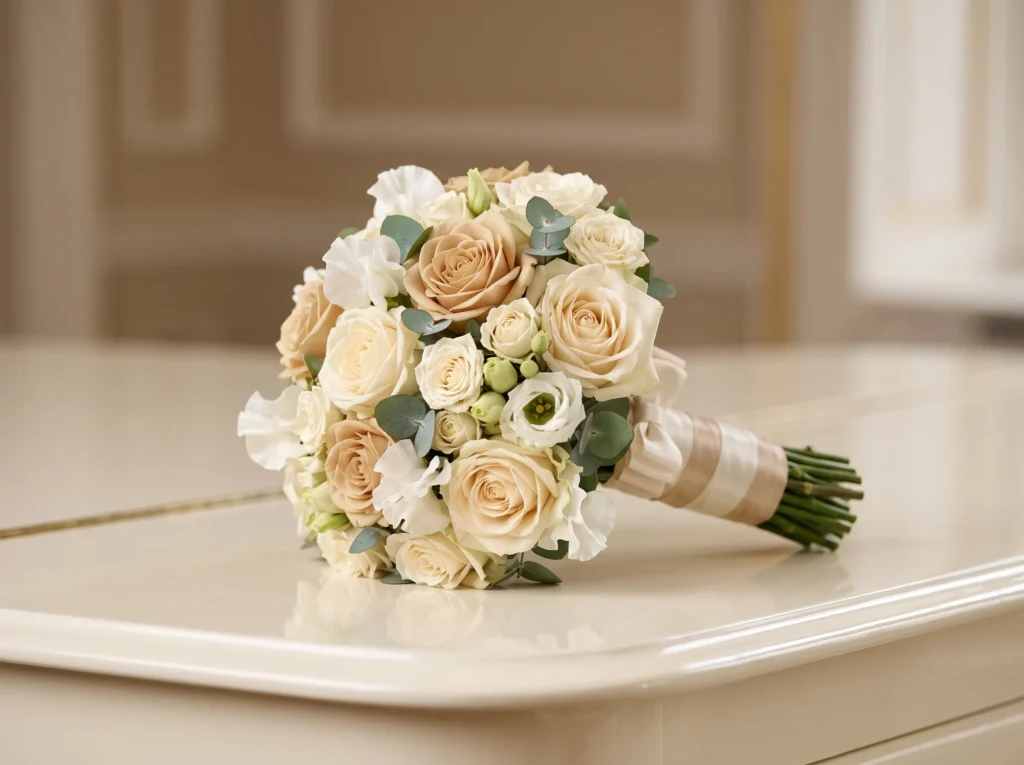
Small scale. Big impact. Round, tightly gathered posy proves champagne romance needn’t sprawl to feel luxurious. Cream and peach roses nestle shoulder to shoulder, sweet pea petals ruffling softly between denser blooms. Eucalyptus peeks through minimally, present but never dominant.
Striped ribbon wrap, pale and precise, gives finished silhouette almost jewel-box quality. Glossy surface below reflects composition, doubling visual richness without adding a single stem. Petite posies suit smaller bridal parties, intimate ceremonies, or brides who prefer flowers proportionate to their frame.
Restraint becomes design philosophy. Every petal chosen with intention. This size proves elegance scales down beautifully.
6. Golden Champagne Harvest
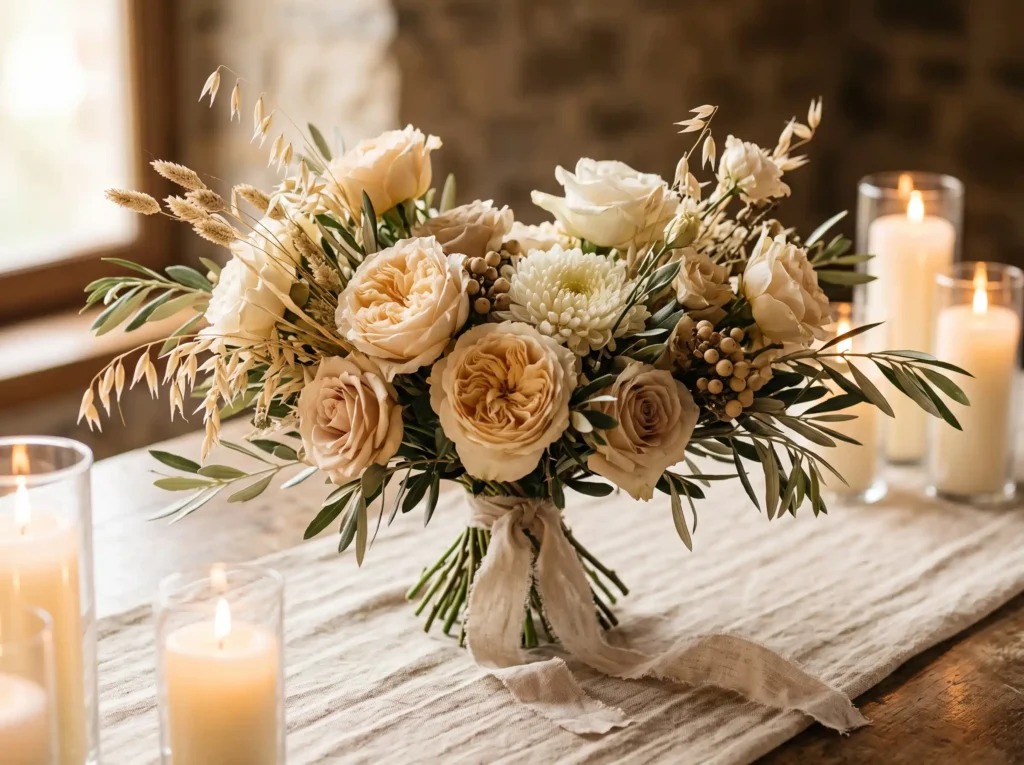
Wheat stalks arc skyward. Oat grass follows, dried and rustling, evoking late-summer fields ready for cutting. Peachy garden roses anchor arrangement’s heart, their ruffled centers glowing amber under candlelight scattered nearby. Chrysanthemum adds pom-pom texture, contrasting rose’s structured layers with looser, daisy-like form.
Candle flames flicker just beyond frame, casting warm light across linen runner and stone backdrop. Harvest imagery feels deliberate—this bouquet belongs to autumn ceremonies, barn venues, tables set beneath string lights.
Dried grasses signal season shifting, wheat symbolizing abundance in countless cultural traditions. Champagne tones here lean warmer, golden rather than icy, matching candlelit mood precisely. Rustic sophistication, harvested and bound.
7. Ivory Champagne Editorial
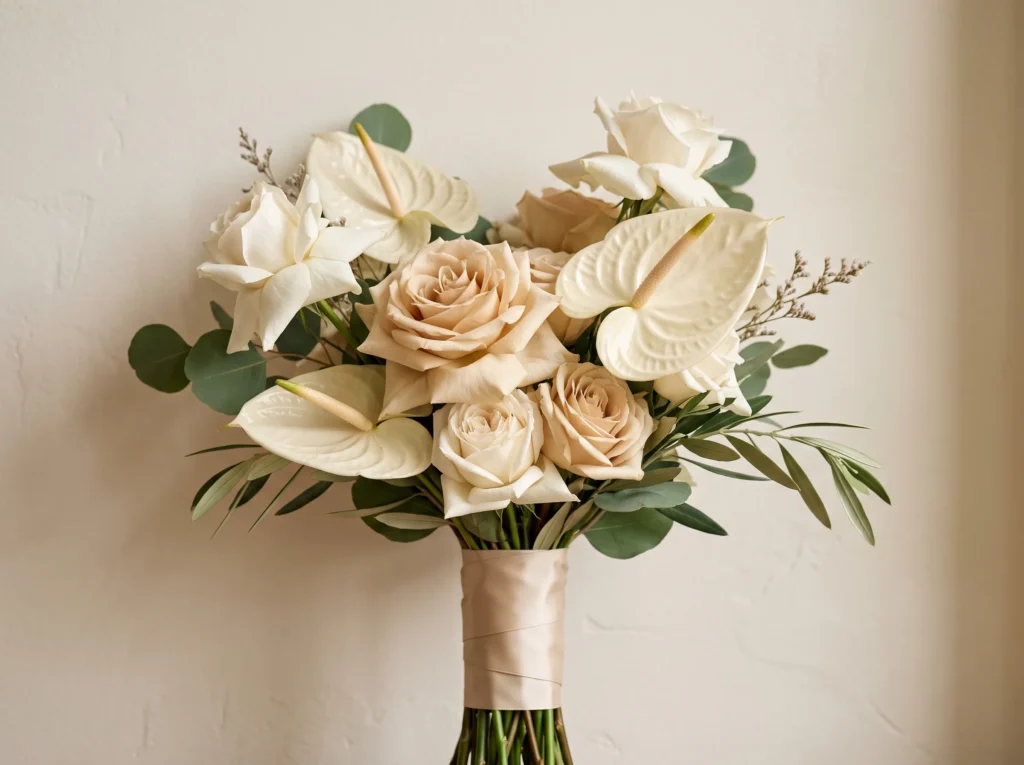
Anthurium’s glossy heart-shaped bracts steal focus immediately. Waxy, sculptural, almost architectural against soft rose petals surrounding them. Unusual choice for bridal work, yet pairing succeeds through contrast—structured tropical bloom against fluffy garden variety, smooth surface against ruffled texture.
Champagne and ivory roses fill remaining space, eucalyptus threading loosely between. Satin ribbon wraps stems in wide, glossy band, matching bouquet’s polished editorial feel. Neutral wall backdrop keeps attention locked on flowers alone, no distraction pulling eye elsewhere.
This combination suits brides wanting something recognizably elegant yet slightly unexpected. Anthurium rarely appears in traditional champagne palettes. Here, it earns its place through sheer sculptural confidence.
8. Champagne English Garden
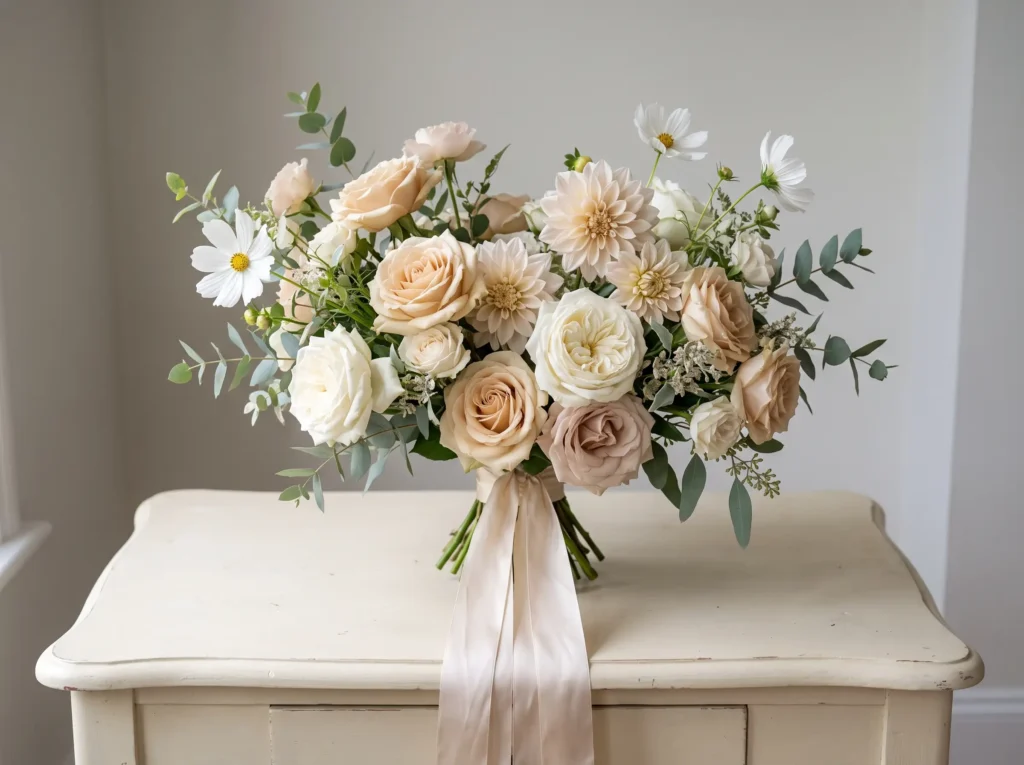
Layers upon layers. Dahlia’s intricate petal arrangement commands center stage, its geometric precision softened by wispy cosmos blooms scattered throughout. White petals flutter almost weightlessly, yellow centers adding tiny pops against dominant cream and blush tones.
Garden-style bouquets thrive on abundance, and this arrangement delivers fully. Roses in varying champagne shades—from pale blush to deeper mauve—create tonal gradient rather than single flat hue.
Ribbon cascades long, pooling against vintage cream dresser below. English garden style traces roots to cottage growing traditions, prioritizing fullness and organic movement over tight structure. Result feels collected across seasons, not assembled in single afternoon. Romantic, layered, unmistakably lush.
9. Champagne Candlelight Bouquet
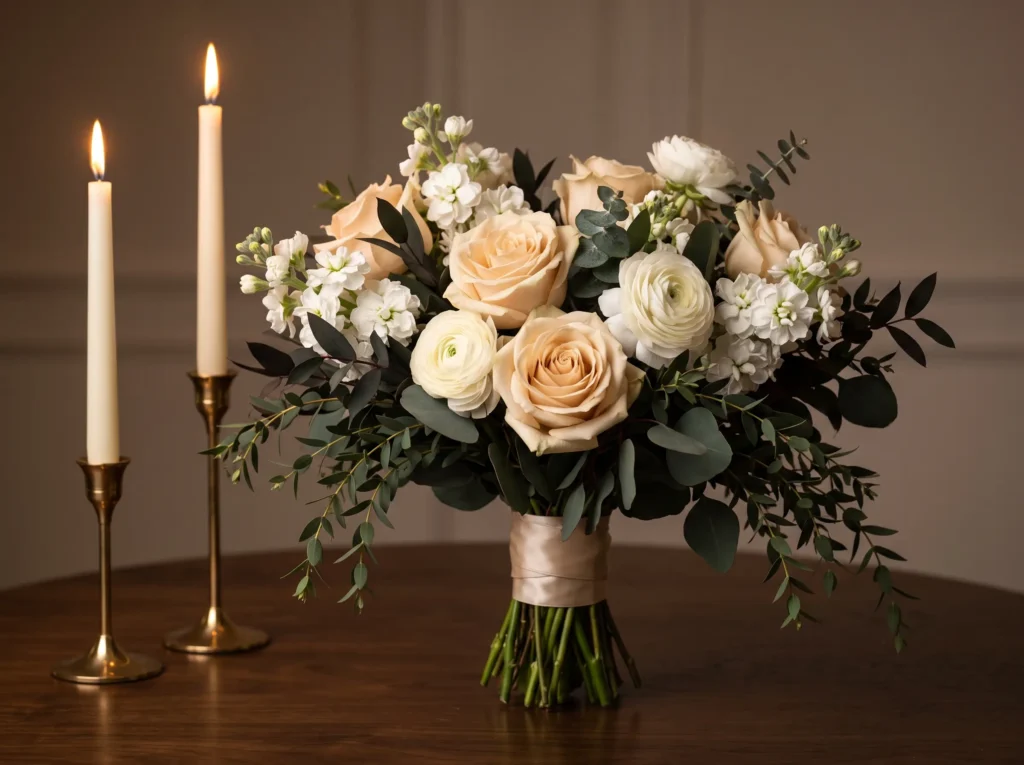
Brass candlesticks flank composition, twin flames casting dramatic shadow across dark wood surface. Ranunculus blooms, their paper-thin petals stacked in perfect spirals, sit alongside champagne roses and fragrant white stock. Stock’s spire-like clusters add vertical lift, breaking round bouquet silhouette into something more dynamic.
Moody backdrop transforms typical daytime florals into evening romance. Warm light flatters champagne tones especially well, deepening cream into gold, softening white into ivory glow.
Eucalyptus trails downward generously, balancing dense floral cluster above with airy greenery below. Evening ceremonies, candlelit receptions, low-lit chapels—this styling whispers intimacy over spectacle. Flame and flower, working together toward same warm effect.
10. Champagne Coastal Luxe
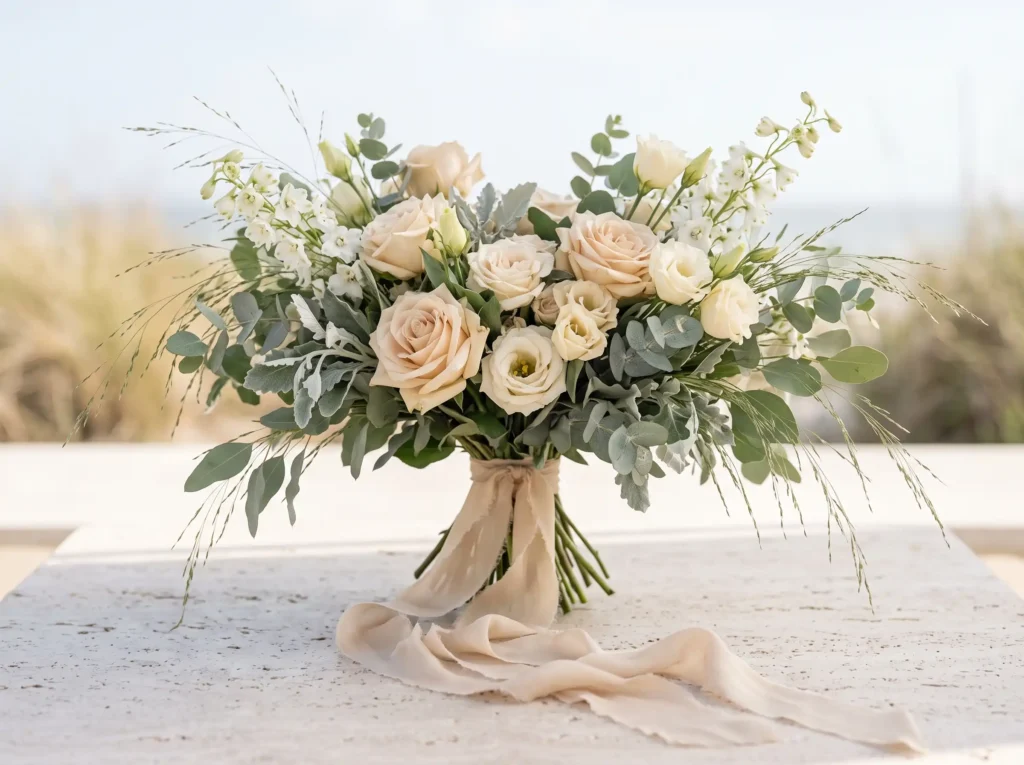
Ocean haze blurs horizon beyond. Silvery dusty miller leaves catch available light, their felted texture standing apart from smooth rose petals nearby. Tall grass stems arc outward dramatically, unbound by tight structure, mimicking wind itself.
Coastal weddings demand florals that read naturally against sand and sea rather than fighting environment. This arrangement answers that brief precisely—loose, textural, sun-bleached in feel. Champagne roses and lisianthus provide soft focal points, while delphinium spikes add subtle height without overwhelming breezy composition.
Frayed ribbon, undone deliberately, continues relaxed narrative established by every other element. Nothing rigid here. Coastal luxury means embracing movement, texture, and light rather than polish alone.
11. Champagne Monogram Bouquet
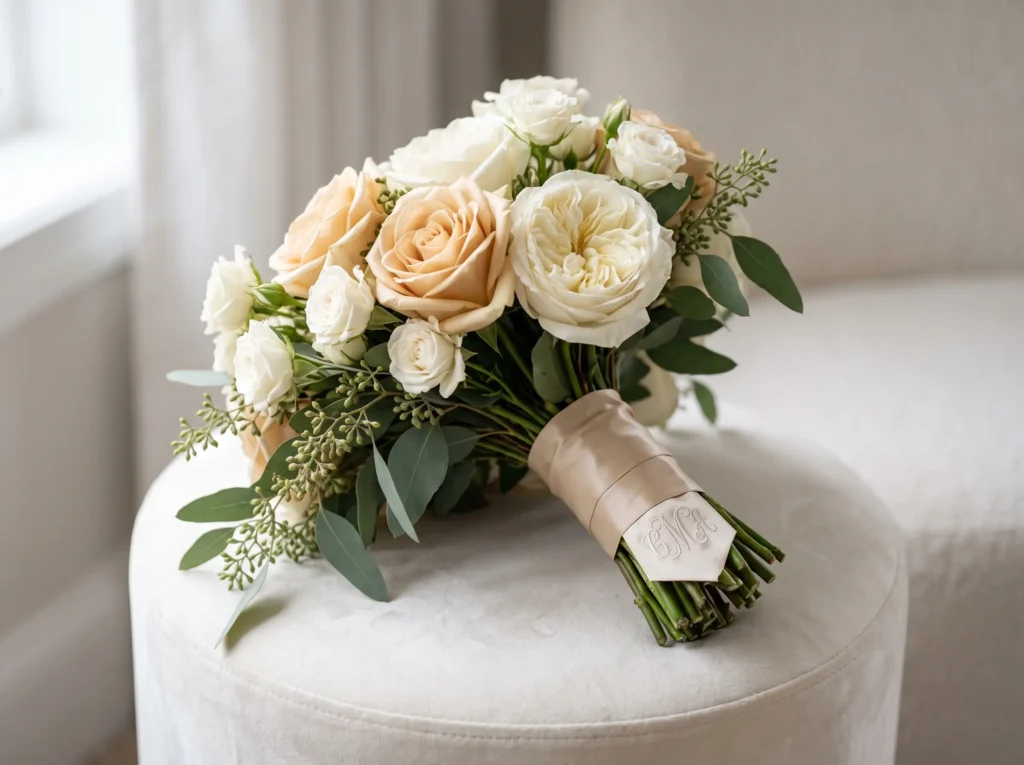
Small flag of satin bears embroidered initials, tucked discreetly among stems. Personal detail, easily missed at glance yet meaningful upon closer look. Champagne and ivory roses cluster densely above, seeded eucalyptus adding delicate silver-green accent throughout composition.
Monogramming bridal bouquets carries sentimental weight—sometimes honoring new married name, sometimes marking family heritage. Placement here feels intentional, positioned where bride’s hand naturally rests during ceremony walk.
Soft focus background, likely bridal suite setting, keeps attention on intimate detail rather than surroundings. This kind of customization appeals to brides wanting heirloom quality within otherwise classic arrangement. Small gesture, lasting sentiment.
12. Champagne Orchid Whisper
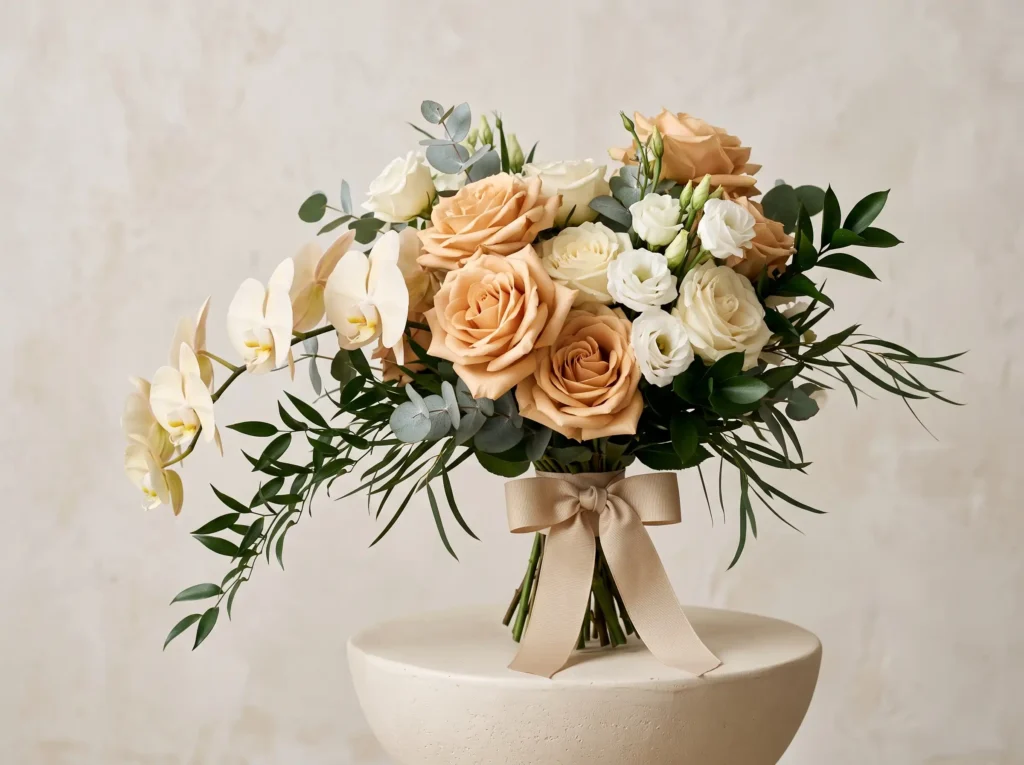
Phalaenopsis orchids curve gracefully leftward, their cream petals almost translucent against denser rose cluster. Unexpected pairing, exotic bloom meeting classic garden variety, yet restraint keeps composition from feeling mismatched. Champagne and white roses dominate visually, lisianthus adding ruffled texture between larger blooms.
Orchids historically symbolize luxury and rare beauty across many cultures, their inclusion signaling elevated occasion. Grosgrain ribbon, tied in neat bow rather than cascading style, suggests polished simplicity over romantic dishevelment.
Pedestal display against warm neutral wall reinforces gallery-like presentation. Brides seeking champagne palette with subtle exotic edge should note orchid placement carefully—too many overwhelms, too few disappears. Balance achieved here, elegantly.
13. Champagne Cottage Romance
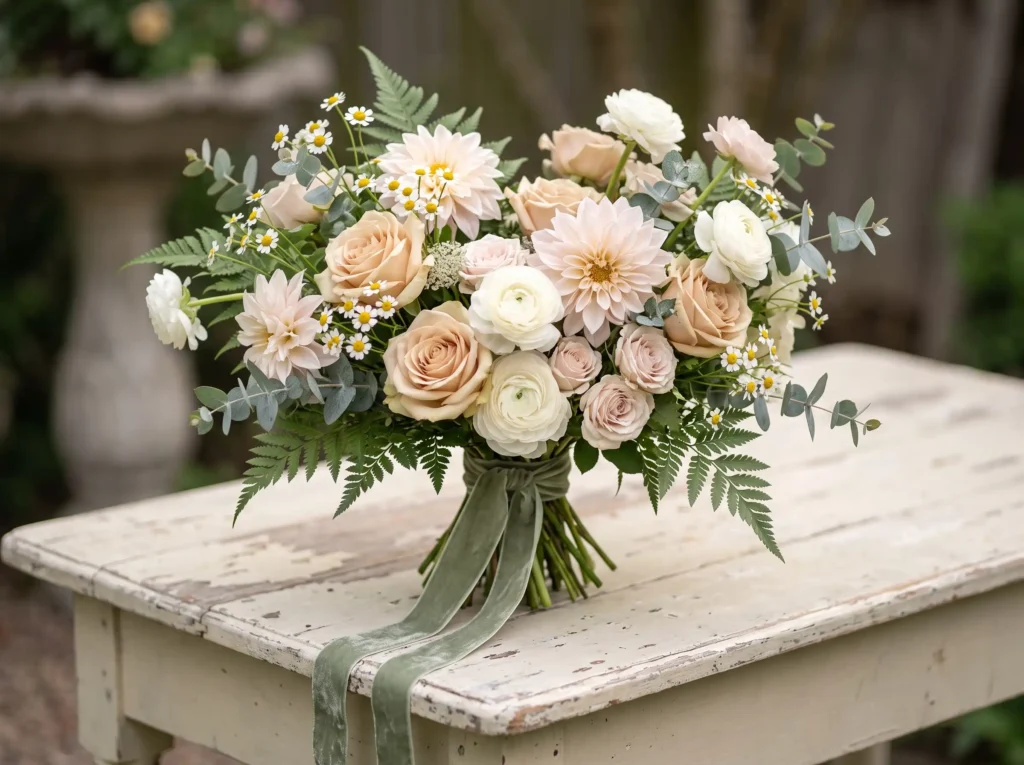
Fern fronds unfurl generously, their feathery structure framing dahlia and ranunculus blooms nestled within. Tiny chamomile flowers scatter throughout like confetti caught mid-air, yellow centers bright against otherwise muted palette. Sage velvet ribbon cascades long, pooling against chippy white table outdoors.
Cottage-style arrangements celebrate imperfection deliberately. Nothing here sits perfectly symmetrical—blooms lean, stems cross, greenery spills beyond expected boundary. Dahlia’s layered petals provide structural anchor amid looser chamomile and fern texture.
Garden setting beyond, dappled and green, reinforces relaxed outdoor narrative. This combination suits brides envisioning storybook romance over polished formality. Every element feels plucked straight from overgrown English garden, gathered rather than engineered.
14. Champagne Silk Sculpture
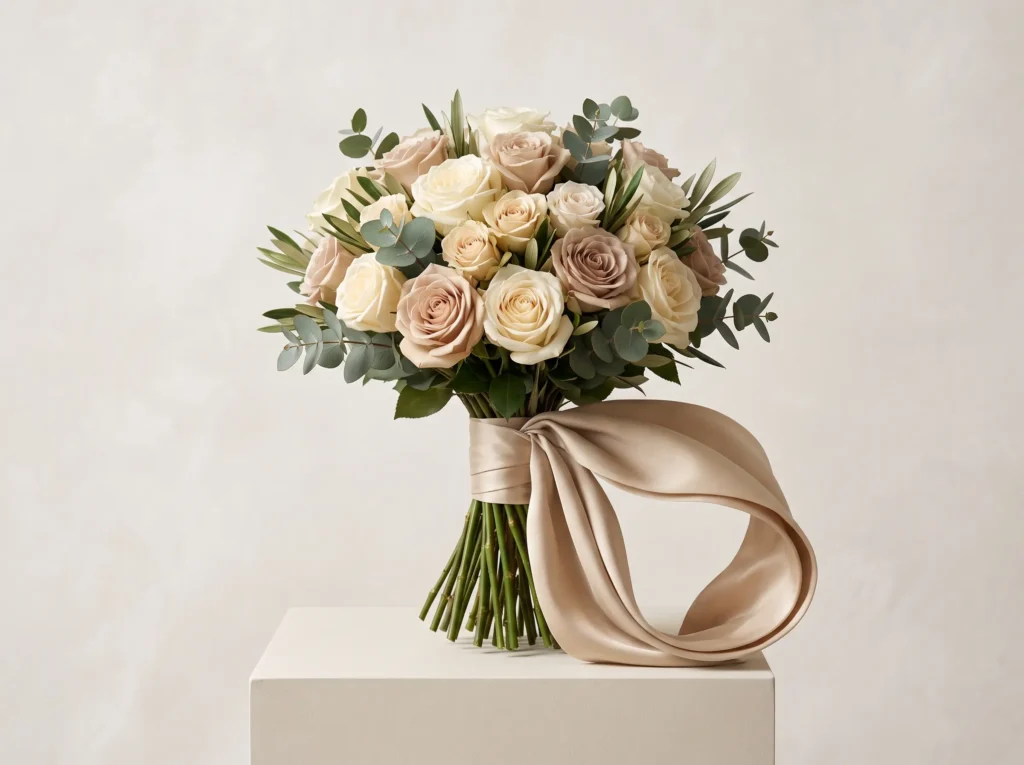
Ribbon becomes protagonist here. Wide silk band, knotted then left to fall in sculptural loop, occupies nearly as much visual space as flowers above. Champagne and blush roses cluster tightly, eucalyptus and olive leaves threading through in muted green counterpoint.
Minimalist white pedestal and backdrop strip away distraction entirely, allowing form and texture full attention. This styling feels closer to fashion editorial than traditional bridal photography, ribbon treated as design element rather than mere finishing touch.
Modern brides pursuing sculptural, gallery-worthy aesthetics will find inspiration in ribbon’s deliberate asymmetry. Simplicity above, drama below—composition proves finishing details deserve as much thought as floral selection itself.
15. Timeless Champagne Clouds
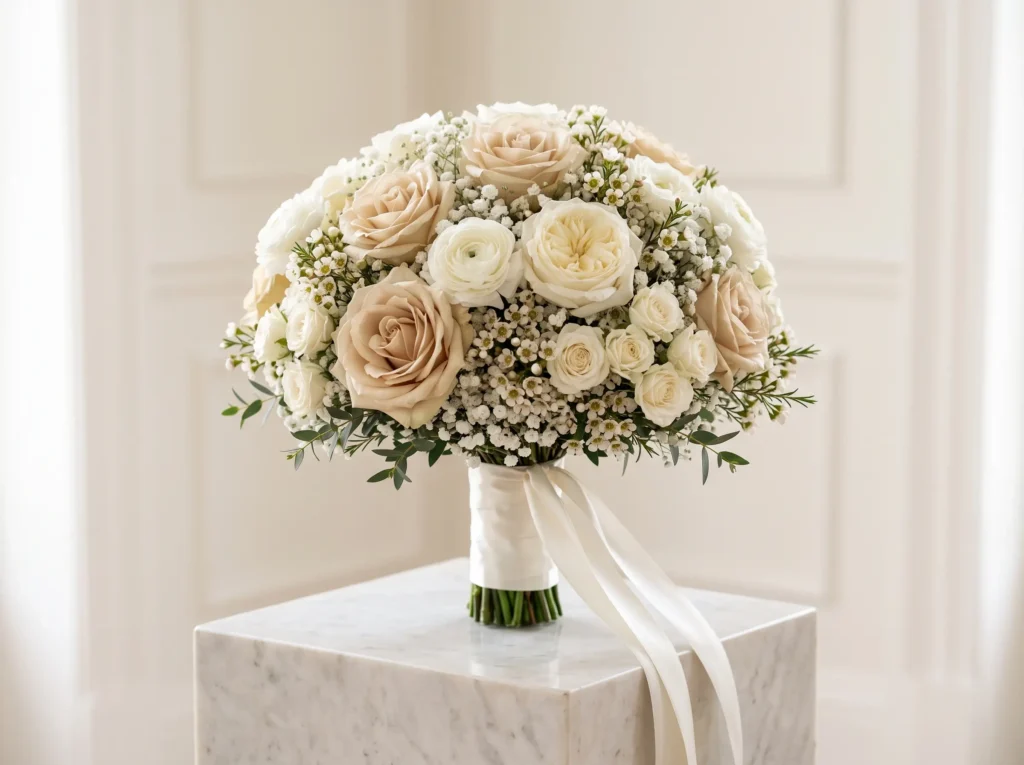
Round, dense, cloud-like silhouette closes collection fittingly. Baby’s breath and wax flower fill every gap between champagne roses and ivory ranunculus, creating soft, uninterrupted texture throughout. No single bloom competes for dominance; instead, collective fullness becomes point itself.
Marble pedestal beneath adds cool, formal counterpoint to warm floral tones above, satin ribbon cascading in generous length down polished stone. This arrangement reads as quintessential bridal silhouette—rounded, symmetrical, abundant without appearing overstuffed.
Fitting closer for any champagne-themed exploration, since it distills every prior theme into single cohesive statement. Soft, timeless, endlessly photographable. Elegance, ultimately, needs no embellishment beyond well-chosen blooms themselves.
final thoughts
The most memorable champagne arrangements rely on contrast and restraint. A sculptural anthurium brings an editorial edge, while dusty miller and tall grasses give a coastal bouquet its loose, wind-swept character. Across all 15 ideas, the palette stays soft while the textures, silhouettes, ribbons, and settings create distinct personalities. The result is a floral style that feels romantic today and easy to love years from now.