The right backyard tent can turn an ordinary lawn into a wedding setting couples never forget. These 14 ideas show how sailcloth peaks, candlelit drapery, orchard branches, hanging florals, and even clear tent roofs can shape the mood from the ground up. Each design uses its surroundings in a different way, creating photo-worthy moments that feel personal rather than staged.
1. Garden Pavilion in Bloom
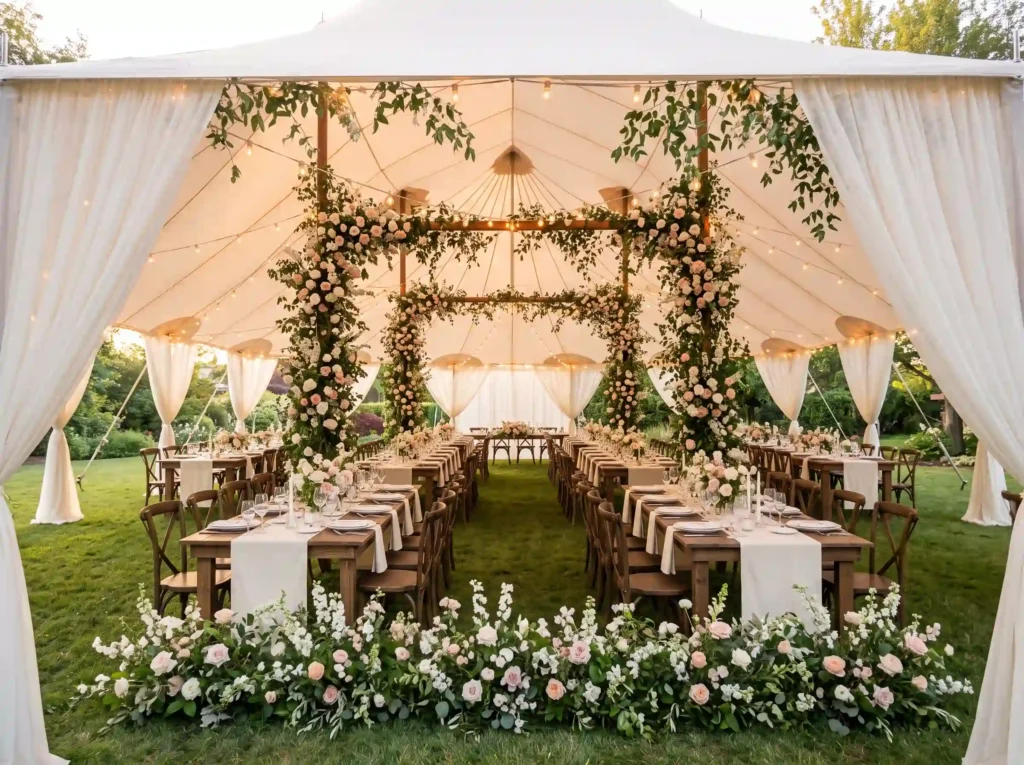
Sailcloth peaks catch dusk light. Underneath, structure meets softness in rare balance. Draped canopy walls, pulled back like curtains, frame lawn and hedgerow beyond — blurring line between tent and garden itself.
Four floral-wrapped posts anchor center aisle, roses and greenery climbing skyward toward a peaked apex. Bistro lights thread through blooms, promising warm glow once sun drops. Long farm tables flank either side, mismatched crossback chairs adding rustic texture against crisp linen runners.
Ground-level flower beds — stock, ranunculus, garden roses — spill along the entrance, echoing overhead arrangements. Repetition matters here; florals above and below create visual rhyme, a technique planners call “vertical layering.” Backyard weddings thrive on this kind of intimacy. Nature does half the decorating.
2. Champagne Draped Dinner Tent
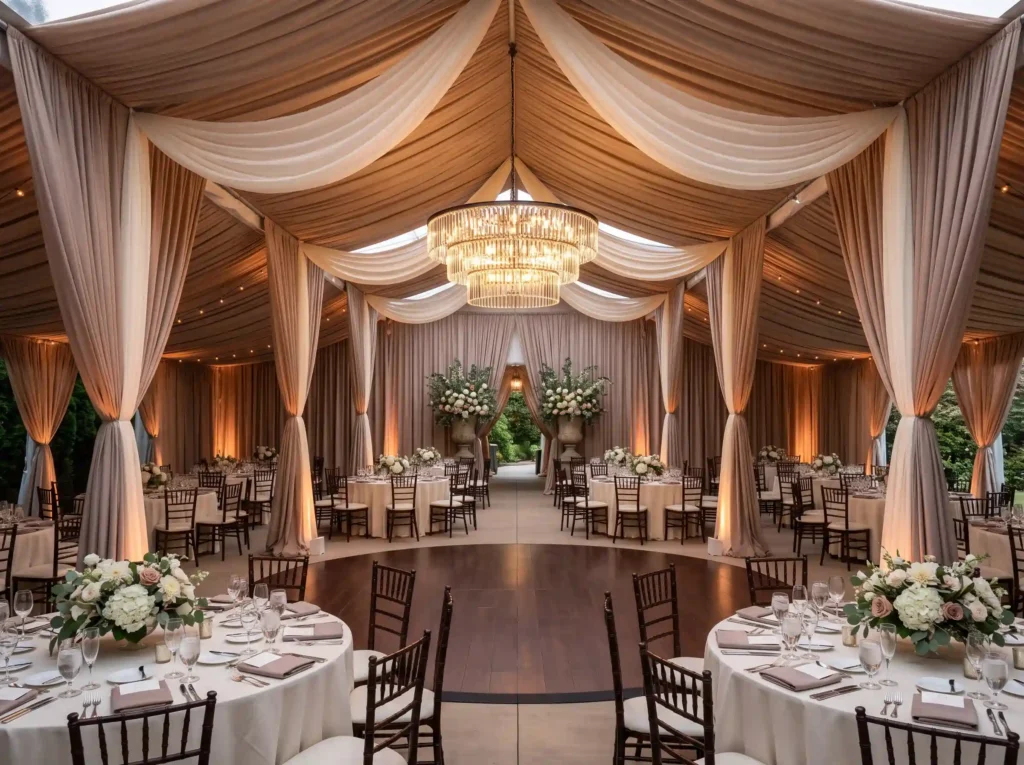
Fabric transforms everything. Champagne-toned drapery, swagged wall to peak, erases any hint of “tent.” What remains reads pure ballroom.
Tiered crystal chandelier anchors center point, hung low enough to feel grand yet intimate. Warmth radiates from amber uplighting hidden behind pillar drapes, a technique borrowed straight from luxury event design. Mahogany chiavari chairs surround round tables — smart choice, since round seating encourages conversation across whole party, unlike long rectangular runs.
Dance floor sits mid-frame, dark wood cutting sharp contrast against ivory linens. Beyond, a draped archway frames garden view, urns of hydrangea marking transition point between structure and yard. Backyard weddings rarely feel this polished. Drapery does heavy lifting — proof that fabric, not architecture, builds atmosphere.
3. Coastal Glasshouse Tent Escape
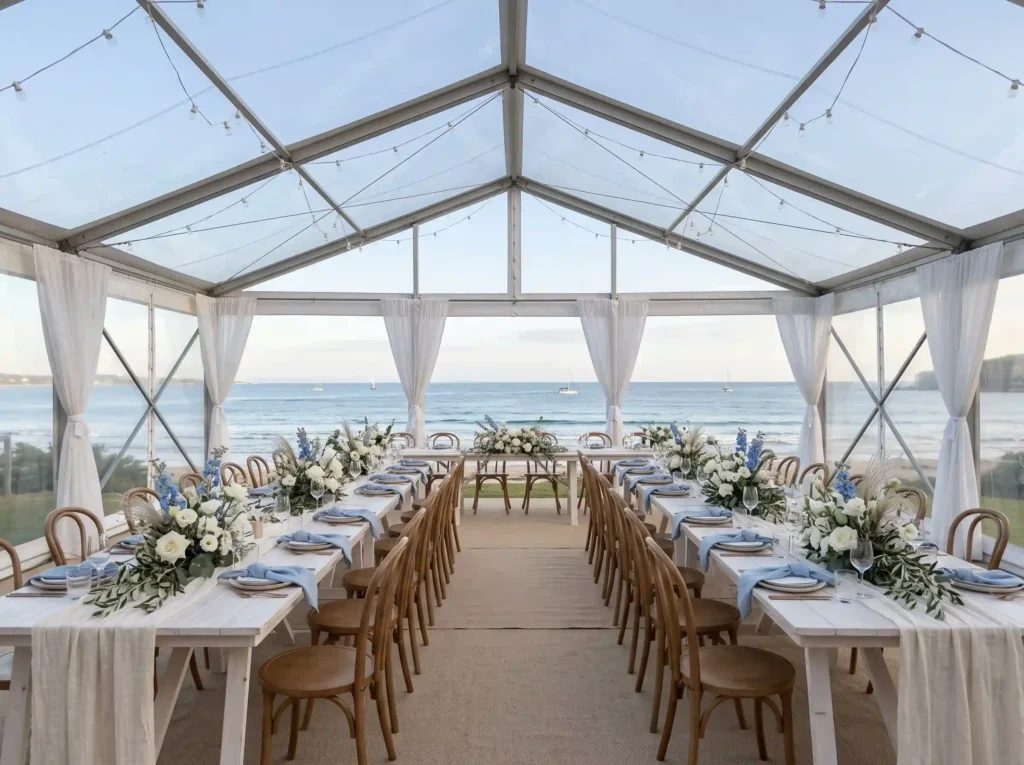
Glass walls change rules entirely. Nothing hidden here. Peaked clear roofline turns tent into skylight, letting sailboats and shoreline become part of decor without lifting a finger.
Bentwood chairs, honey-toned, line long communal tables — a nod to coastal casual over formal ballroom stiffness. Dusty-blue napkins knot against white linen, echoing sea tones outside. Smart palette choice; borrowing color from surroundings ties interior to exterior seamlessly.
Delphinium spikes and pampas grass mix with white roses down table runners, texture doing quiet work alongside color. Sheer curtain panels soften structural beams, framing water views like paintings. Backyard-adjacent, beachfront-adjacent — glasshouse tents blur category lines. Setting becomes guest of honor.
4. Modern Black-and-Ivory Backyard Canopy
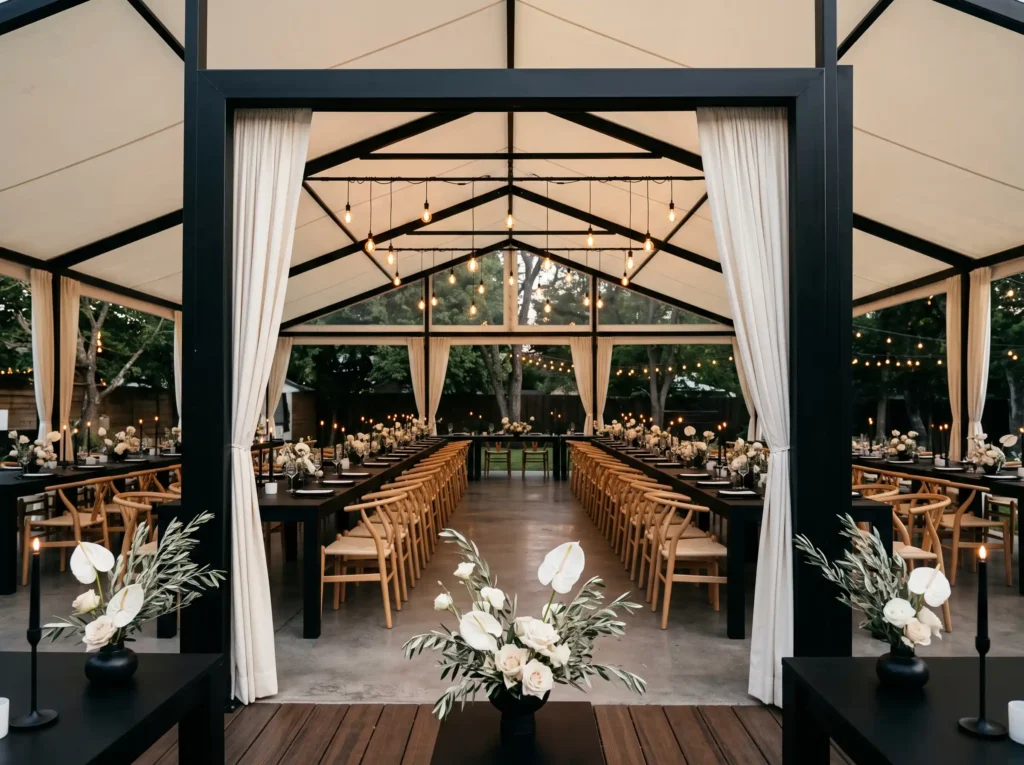
Contrast rules this frame. Black exposed trusswork, sharp against cream canvas, reads more architecture than tent. No apology for structure here. Beams stay visible, celebrated even.
Matte black tables run the length, wishbone chairs in warm wood breaking up all that dark line-work. Bare-bulb pendants drip from ridge beam like punctuation — irregular, sculptural, deliberately imperfect. Anthurium blooms, waxy and white, punctuate arrangements alongside garden roses and olive branch, a pairing more tropical-modern than traditional garden party.
Black taper candles flank low-slung vases, restraint replacing abundance. Curtain panels soften only where needed. Result feels less “backyard tent,” more design-forward pavilion — proof modern couples increasingly treat structure itself as design statement, not backdrop.
5. Tuscan Citrus Dinner Tent
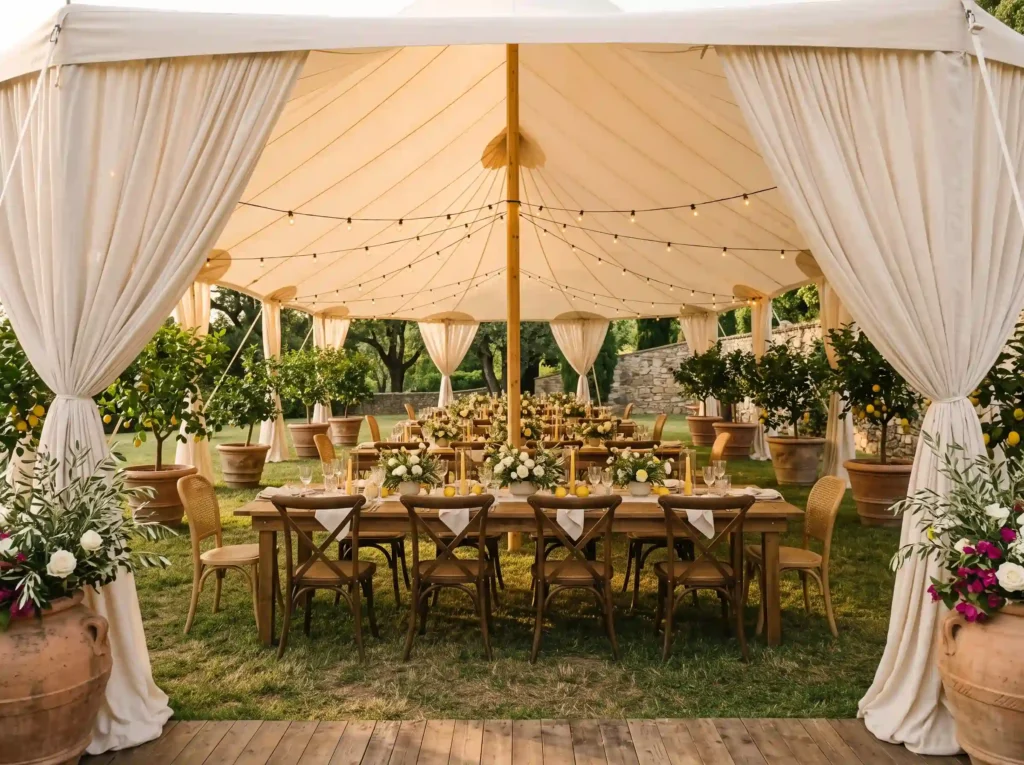
Potted lemon trees ring tent’s edges, fruit dangling like ornaments nature grew itself. Golden hour hits sail-shaped canvas, warming everything beneath to amber. Central wooden pole splits table into two long runs, string lights radiating outward like sun rays traced in bulbs.
Cross-back chairs, honeyed wood, pull double duty — rustic yet refined. Lemons scattered along centerpieces echo trees outside, tying tablescape to setting directly. Stone wall backdrop hints old-world countryside, Provence or Italy, though yard stays firmly backyard.
Citrus theming rarely goes wrong; scent, color, symbolism of abundance all converge. Simple trick, big payoff — let landscaping become the florist.
6. Midnight Blue Stargazer Tent
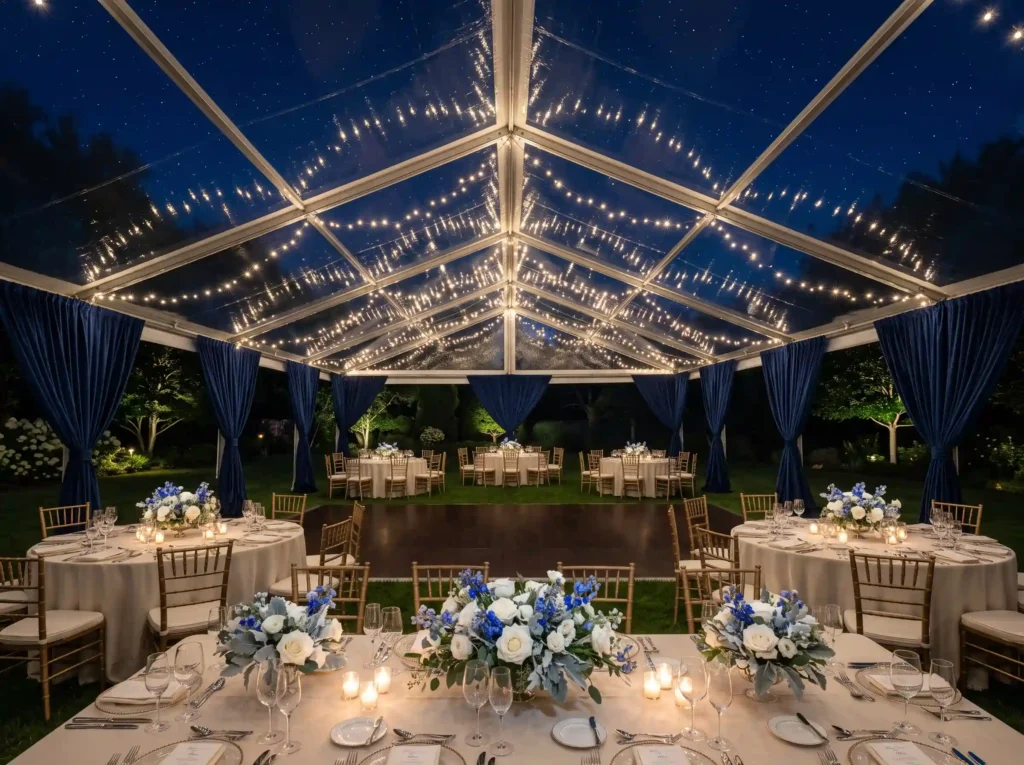
Darkness works differently here. Clear-top tent vanishes against navy sky, stars visible through structural grid, string lights doubling as constellation stand-ins. Deep sapphire velvet drapery replaces daytime white — bold choice, signaling formal evening affair over casual garden gathering.
Gold chiavari chairs catch candlelight, warm metal against cool velvet backdrop. Round tables cluster loosely around open dance floor, blue delphinium and white rose centerpieces bridging linen and drapery tones.
Candlelight does most work after sundown; dozens of tapers and votives replace daylight entirely. Nighttime tents demand different math than daytime ones — lighting becomes architecture, not accent. Result: genuinely celestial.
7. Cottagecore Lace Tent10.
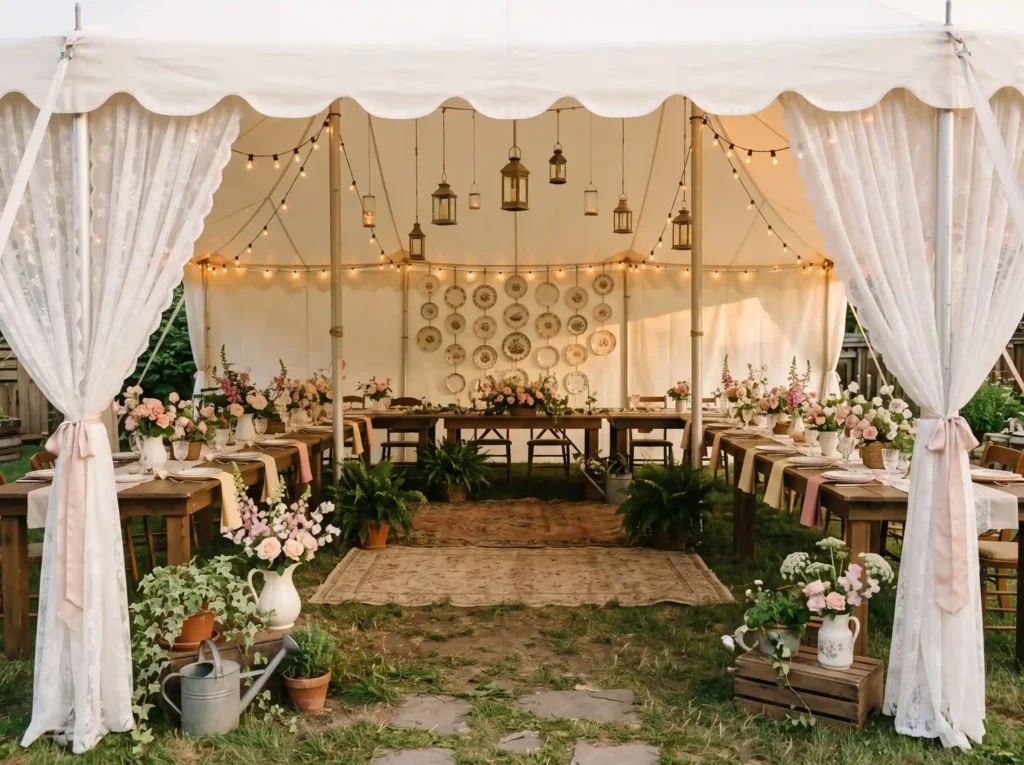
Scalloped tent edges, trimmed in lace, soften every line. Nothing sharp here. Vintage plates hang mismatched against back wall — flea-market finds turned art installation, a technique gaining traction among maximalist planners tired of matching sets.
Wrought-iron lanterns dangle at staggered heights, candlelight flickering through amber glass. Farm tables run parallel, blush and cream runners layering softly beneath scattered stoneware pitchers stuffed with garden roses.
Worn Persian rugs anchor aisle underfoot, ferns spilling from terracotta pots nearby. Watering can, ivy, crate stacks — props doing narrative work, suggesting garden just tended. Cottagecore thrives on imperfection dressed as heirloom. Charm over polish, always.
8. Desert Sunset Canvas Tent
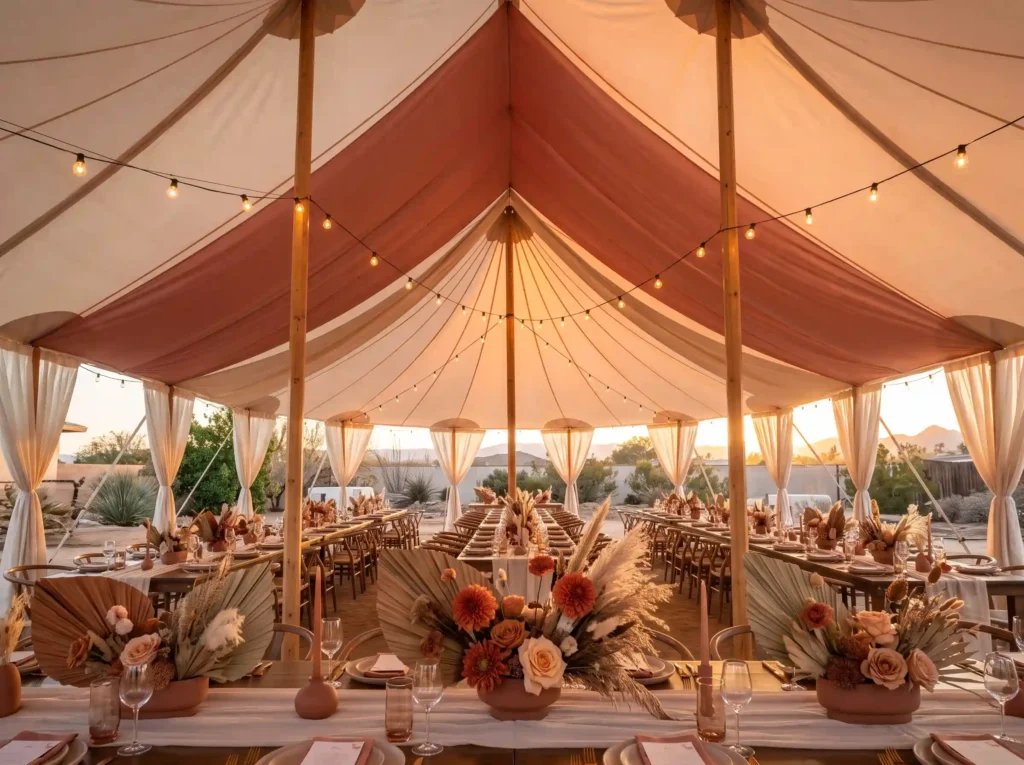
Rust-colored canvas glows against setting sun, color choice mirroring desert itself rather than fighting it. Dried palm fronds fan outward from centerpieces, texture standing in where greenery usually goes — smart substitution, since fresh foliage wilts fast in arid heat.
Pampas grass and dahlia blooms in burnt orange, dusty rose carry warmth through long tables. Distant mountains, cacti silhouettes visible past curtain gaps, remind guests exactly where they’ve landed.
Wishbone chairs, pale wood, contrast against darker table stain. Desert weddings succeed by leaning into climate, not disguising it. Sunset itself becomes final decoration — free, fleeting, unrepeatable.
9. Botanical Greenhouse Tent
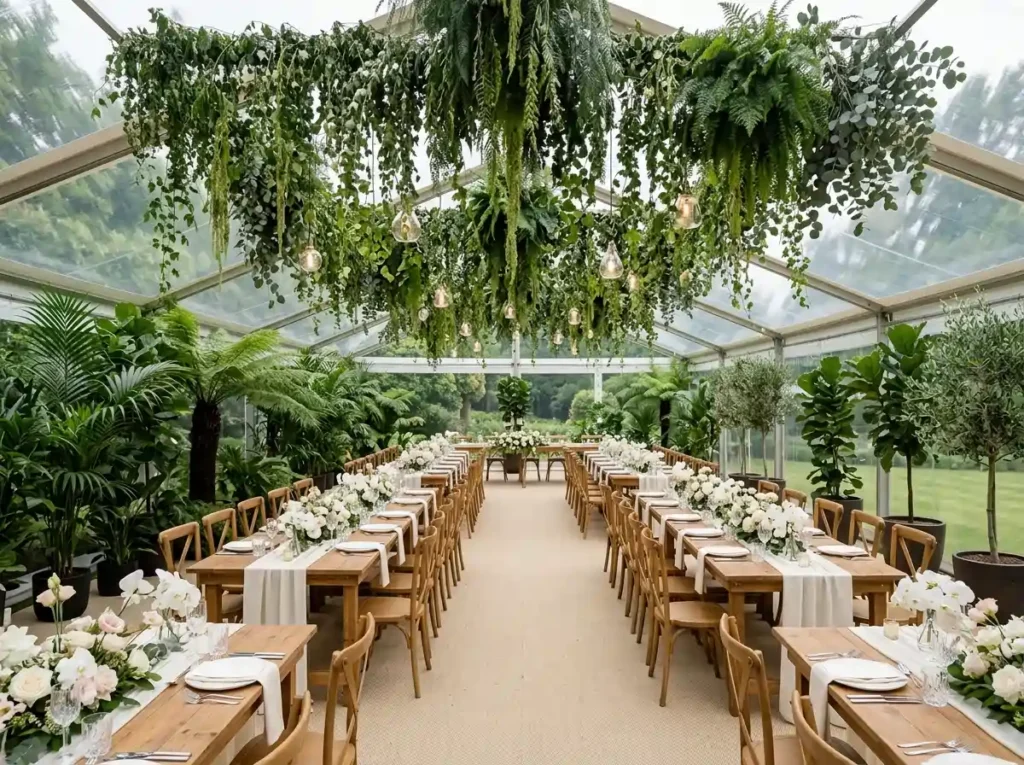
Ferns cascade downward, suspended in dense clusters overhead — less centerpiece, more living chandelier. Clear tent roof lets daylight filter through trailing vines, greenhouse effect achieved without actual glasshouse. Potted palms and fiddle-leaf figs crowd tent perimeter, blurring boundary between indoor seating and surrounding garden.
Long wooden tables run in mirrored rows, white florals kept intentionally simple against overwhelming greenery above. Restraint matters here; too much bloom would compete with foliage drama already commanding attention.
Amber glass votives dot runners, small warm points against cool green canopy. Botanical tents work best when structure disappears entirely — nature, not fabric, becomes the architecture guests remember.
10. Romantic Blush Ballroom Tent
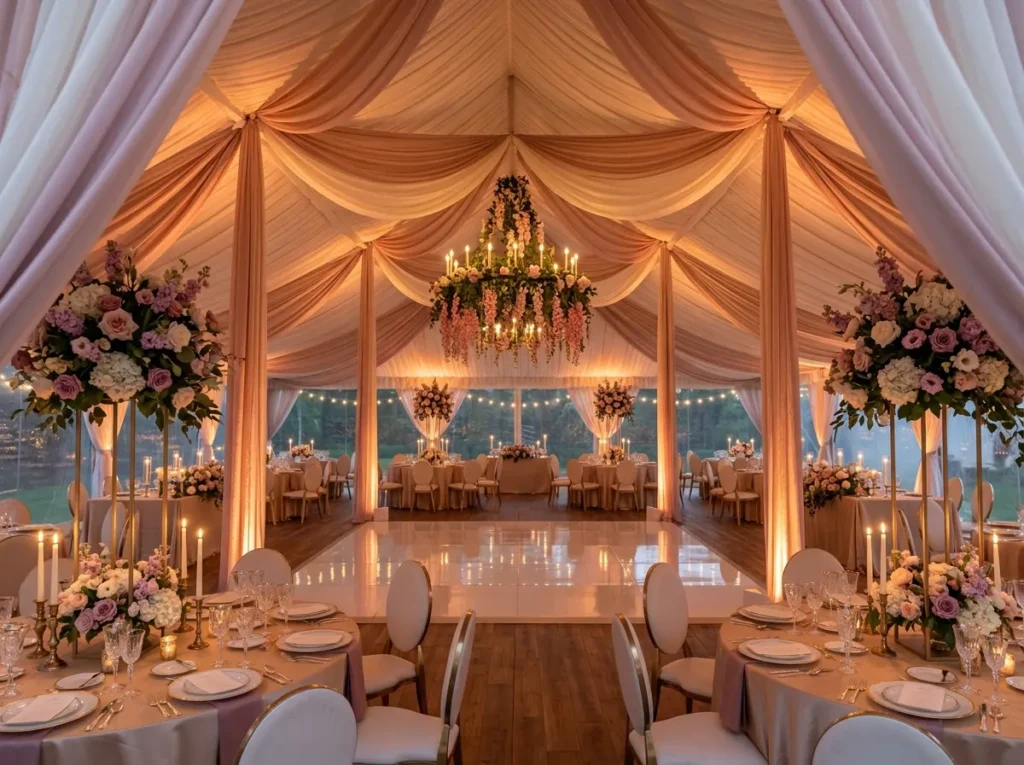
Swagged blush and mauve fabric pools from peak downward, a floral-and-greenery chandelier hanging dead center like jewelry for the ceiling itself. Reflective white dance floor doubles the glow, mirroring candlelight back upward.
Oval-back chairs, cream upholstery, ring round tables dressed in soft champagne linen. Tall floral arrangements — hydrangea, garden rose, stock — rise on gold stands, height doing visual work long tables can’t achieve.
Warmth radiates from uplighting tucked behind drapery folds, same trick seen in luxury ballrooms citywide. Backyard becomes indistinguishable from five-star venue. Proof fabric and lighting, layered correctly, out-earn architecture every time — romance engineered, not accidental.
11. Green and White Farm Dinner
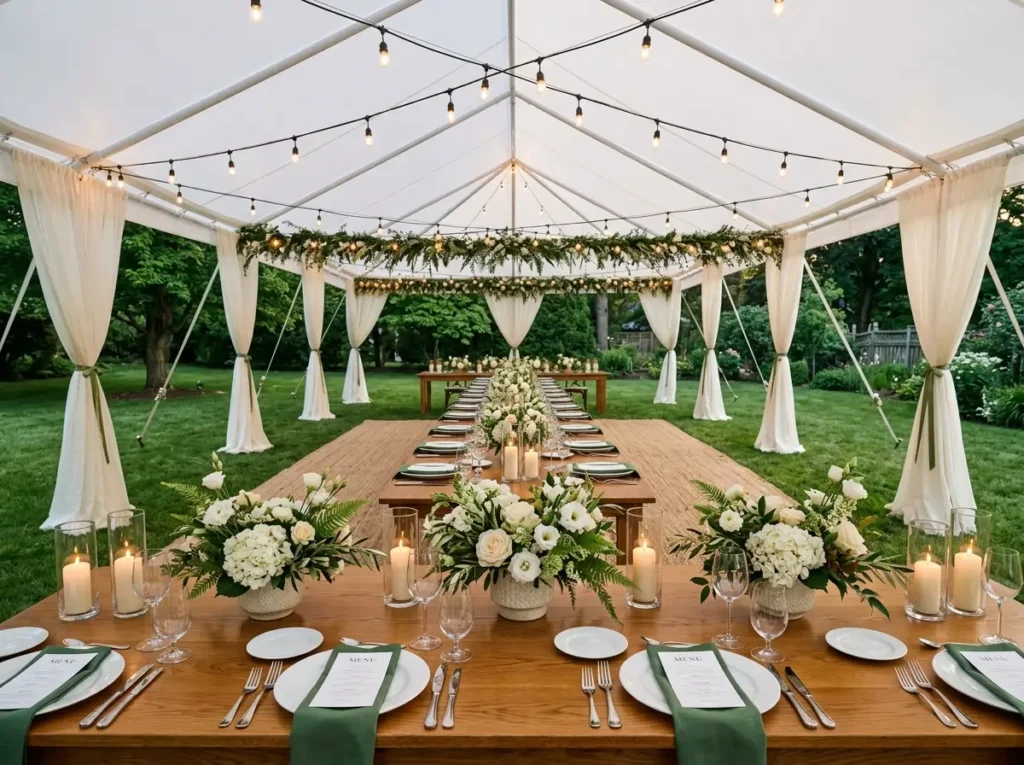
Restraint reads confident here. Single garland threads across crossbeam, greenery kept spare rather than abundant. White canvas stays plain, unadorned except string lights crisscrossing overhead in loose grid pattern.
Long wooden table anchors center, benches replacing chairs — farmhouse logic, communal by design. Forest-green napkins snap against white china, small color choice carrying whole palette. Hydrangea and rose centerpieces stay low, letting candlelit hurricanes take visual lead instead.
Menu cards sit precisely at each setting, formal touch inside otherwise rustic frame. Farm dinners succeed through subtraction, not addition — every extra element removed until only essentials remain. Quiet elegance, intentionally.
12. Moroccan Lantern Garden Tent
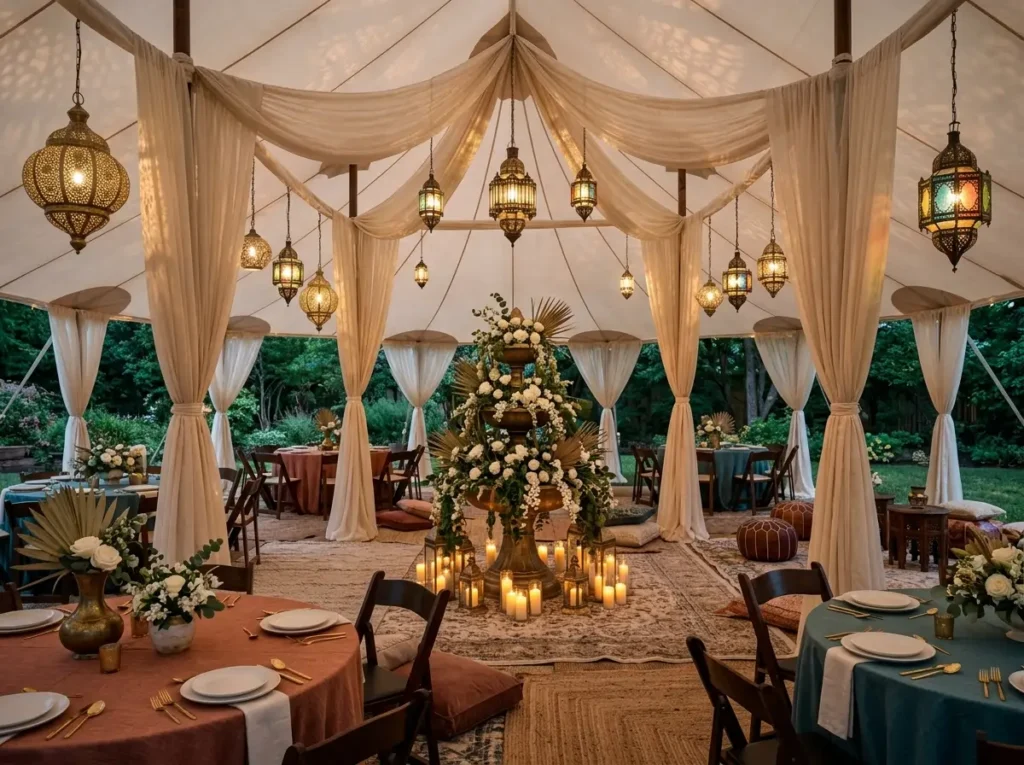
Dozens of pierced-metal lanterns hang at uneven heights, candlelight scattering through cutout patterns onto draped cream fabric above. Effect reads more souk than backyard — intentional cultural borrowing, executed with real texture depth.
Floor cushions and low poufs cluster near center fountain, itself overflowing with white roses and palm fronds ringed by dozens of pillar candles. Layered rugs, jewel-toned tablecloths — rust, teal — reject matching-set convention entirely.
Wooden folding chairs stay simple, letting textiles and lighting carry visual weight instead. Maximalist approach, executed with restraint in furniture choice. Global-inspired décor works when authenticity, not costume, guides selection — warmth over spectacle.
13. Orchard Lantern Supper Tent
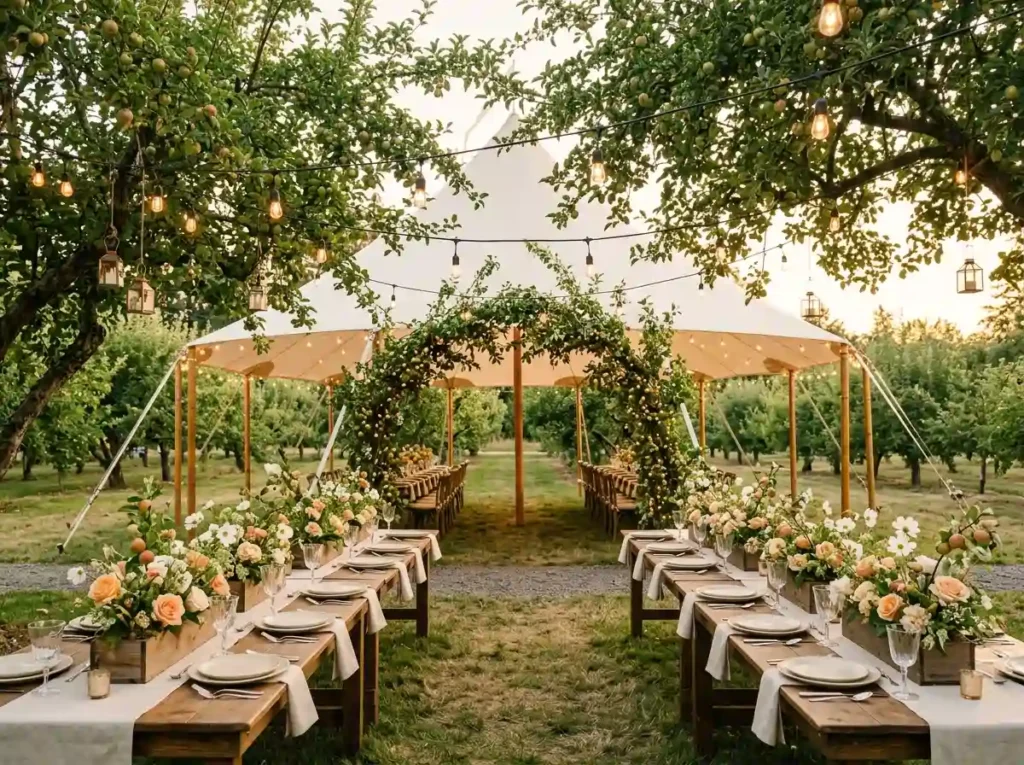
Apple branches arch overhead naturally, string lights and lanterns threaded straight through limbs rather than tent structure. Sailcloth peaks rise modestly between rows, almost secondary to orchard itself.
Twin floral arches, greenery-wrapped, mark entrance beneath tent peak — echoing tree canopy above in cultivated form. Long benches replace chairs entirely, communal seating suited to harvest-supper mood. Peach and white blooms in wooden crates continue orchard’s color story down each table length.
Golden hour light filters through leaves, dappling everything below. Orchard venues offer built-in romance no rental company can replicate — real trees, real fruit, real shade. Backyard tents rarely borrow this much from surrounding land.
14. Floating Floral Canopy Reception
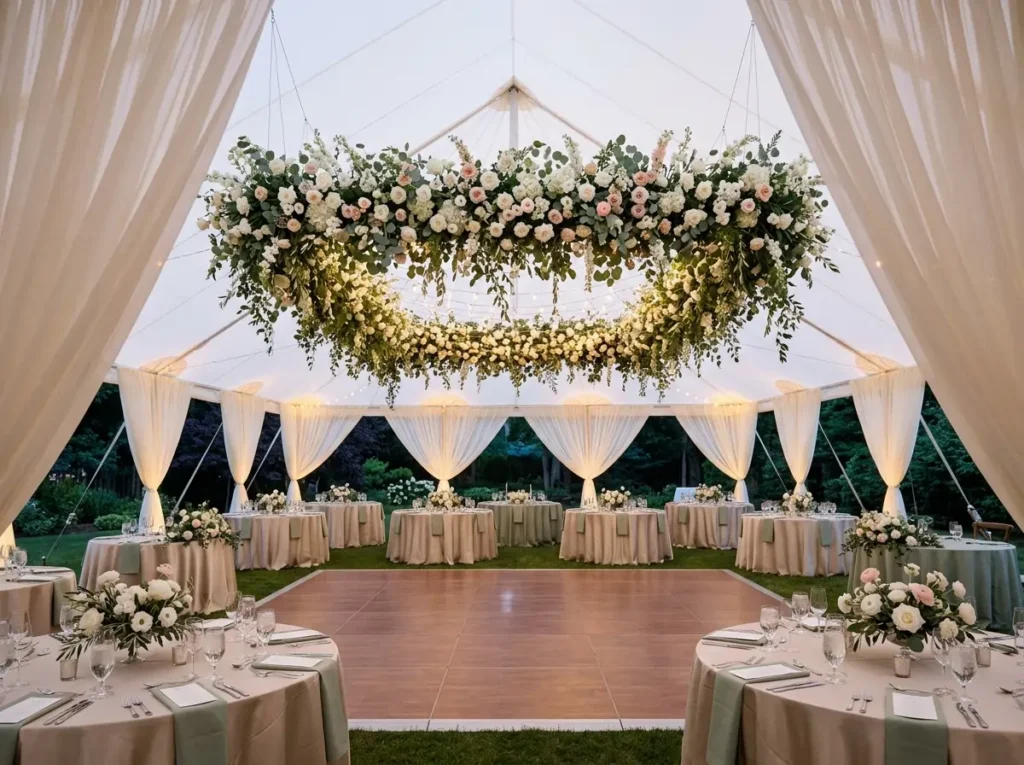
Enormous circular garland hovers above polished wood floor, blush and ivory blooms cascading downward like chandelier reimagined in petals. Scale alone commands attention — this isn’t accent, it’s centerpiece for entire reception.
Sheer draped walls fall in soft folds around perimeter, uplighting warming fabric to gold at dusk. Round tables, sage and blush linens alternating, ring dance floor’s edge without crowding it. Rose, ranunculus, hydrangea repeat in smaller table arrangements, tying ground-level florals back to floating installation overhead.
Suspended florals demand serious rigging and budget, but payoff shows instantly — every photo taken beneath frames couple inside living wreath. Backyard tent, transformed into stage set.
final thoughts
The strongest backyard tent designs make the setting part of the celebration. A Tuscan-inspired tent lets lemon trees and golden light carry the scene, while a midnight-blue canopy uses candlelight and a clear roof to turn the evening sky into décor. These ideas prove a tent can feel rustic, romantic, modern, or wildly dramatic without losing the intimacy of a backyard wedding.