Beautiful wedding flowers don’t have to come with a luxury price tag. These 19 simple wedding flower ideas show how thoughtful flower choices, soft color palettes, and natural textures can create bouquets that look elegant without stretching your budget. From crisp calla lilies wrapped in satin to meadow-inspired wildflowers, lush hydrangeas, and romantic garden roses, each arrangement proves that simplicity often leaves the strongest impression.
1. Ivory Calla Grace
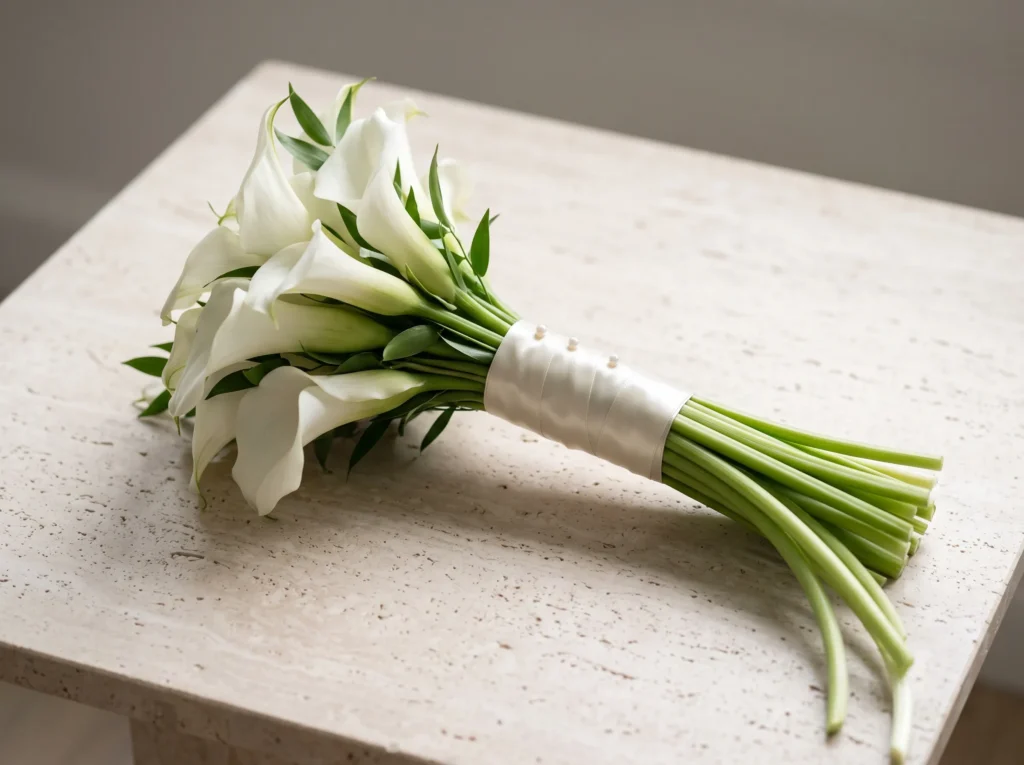
Clean lines. Nothing extra. Calla lilies do more with less, and this bundle proves it. Each bloom curls into a single, trumpet-shaped petal — no ruffles, no layering, just pure form. That architectural quality makes calla a favorite among florists chasing minimalism without sacrificing drama.
Long stems stay bare, gathered tight, wrapped in ivory satin ribbon studded with small pearl pins. Simple detail. Big payoff. Slender greenery threads through the blooms, softening what could read austere.
Budget-wise, calla lilies punch above their cost — few stems fill a hand beautifully, unlike fuller varieties needing volume. Travertine stone backdrop echoes the bouquet’s neutral palette, reinforcing quiet elegance over ornate excess. Timeless, not trendy.
2. Blush Garden Romance
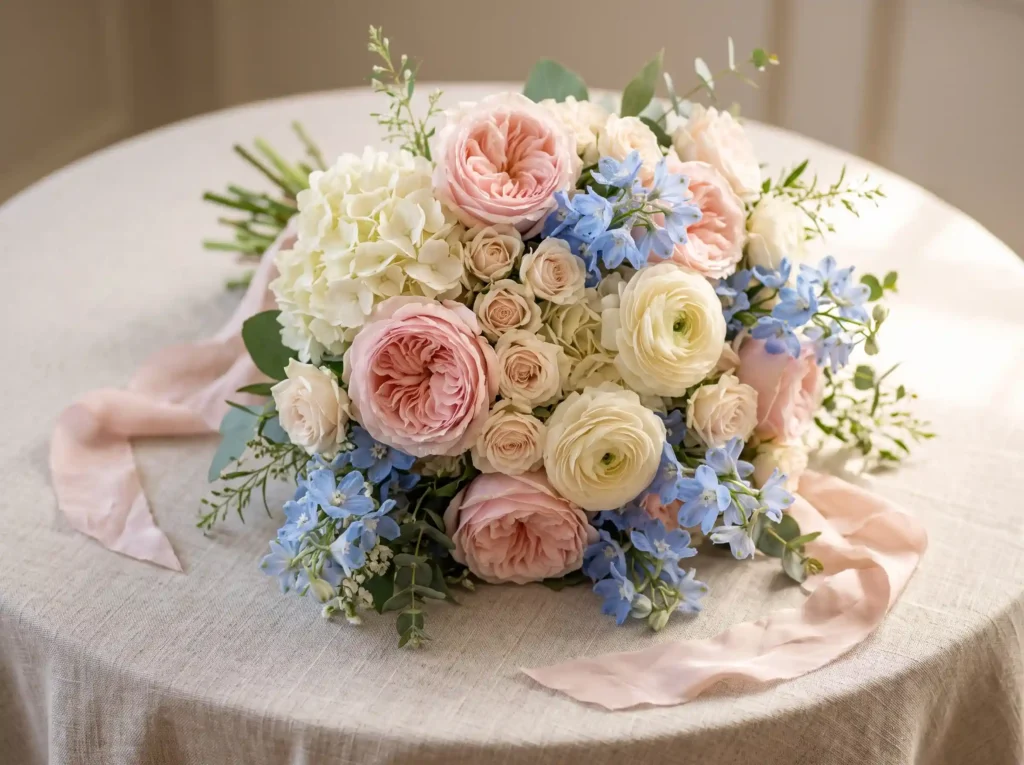
Fullness, achieved gently. Bouquet reads like a garden mid-bloom, dozens of textures crowding together without chaos. David Austin roses anchor center stage — those tight, swirling petals folding inward, layer after layer, signature of the variety. Ranunculus tucks beside them, papery and pale, mimicking rose form on a smaller scale.
Delphinium spikes add lift. Cool blue against warm blush, a small but purposeful contrast. Spray roses fill gaps, keeping density high without heaviness. White hydrangea, meanwhile, works as filler flower, bulking volume affordably — a florist’s trick for maximizing impact per dollar.
Trailing ribbon in dusty rose ties palette together, cascading loose across linen. Cottage garden romance, distilled.
3. Peach Meadow Bloom
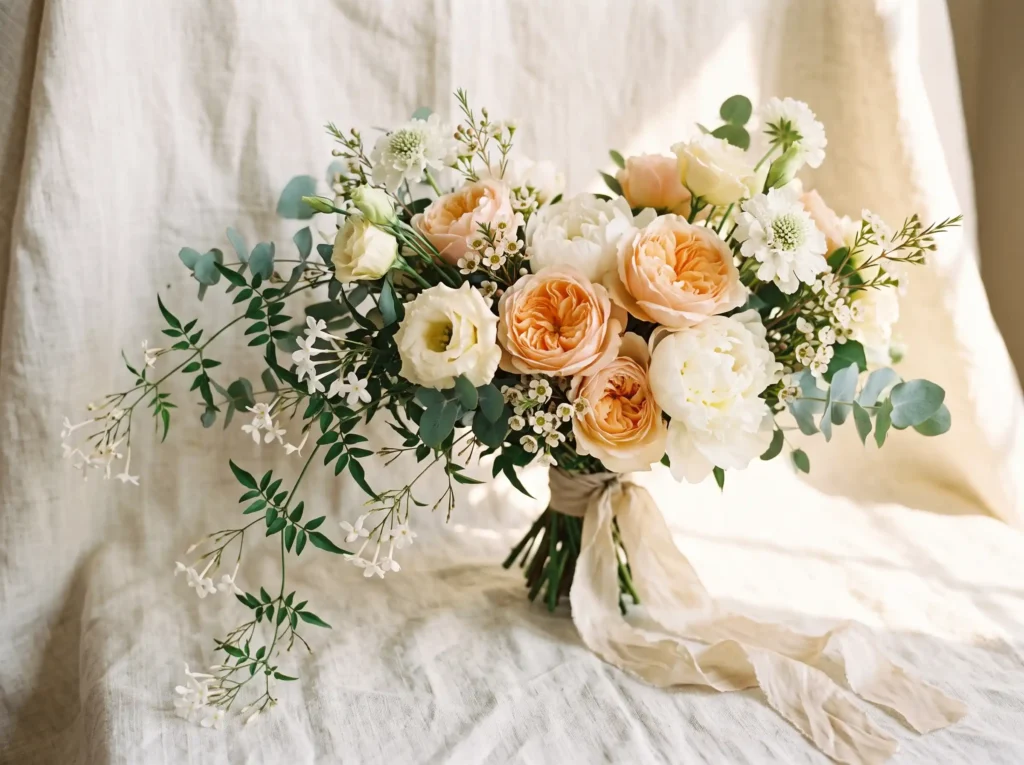
Structure loosens here. Where earlier bouquets tighten inward, this one spills outward, branches reaching in every direction. Jasmine vine trails low, almost forgotten at the edges — a florist’s move borrowed straight from meadow foraging, not formal arranging.
Peach garden roses hold warmth at center, echoed by creamy peonies nearby, their ruffled heads soft as tissue paper. Lisianthus, often mistaken for rose, adds open-faced contrast — flatter, simpler blooms breaking up density. Tiny wax flower clusters and pincushion scabiosa scatter texture throughout, like confetti caught mid-air.
Eucalyptus does heavy lifting, dusty green against linen backdrop. Sunlight, soft and diffused, flatters every color. Gauze ribbon, undone, mirrors bouquet’s unstructured spirit. Effortless, genuinely.
4. White Meadow Simplicity
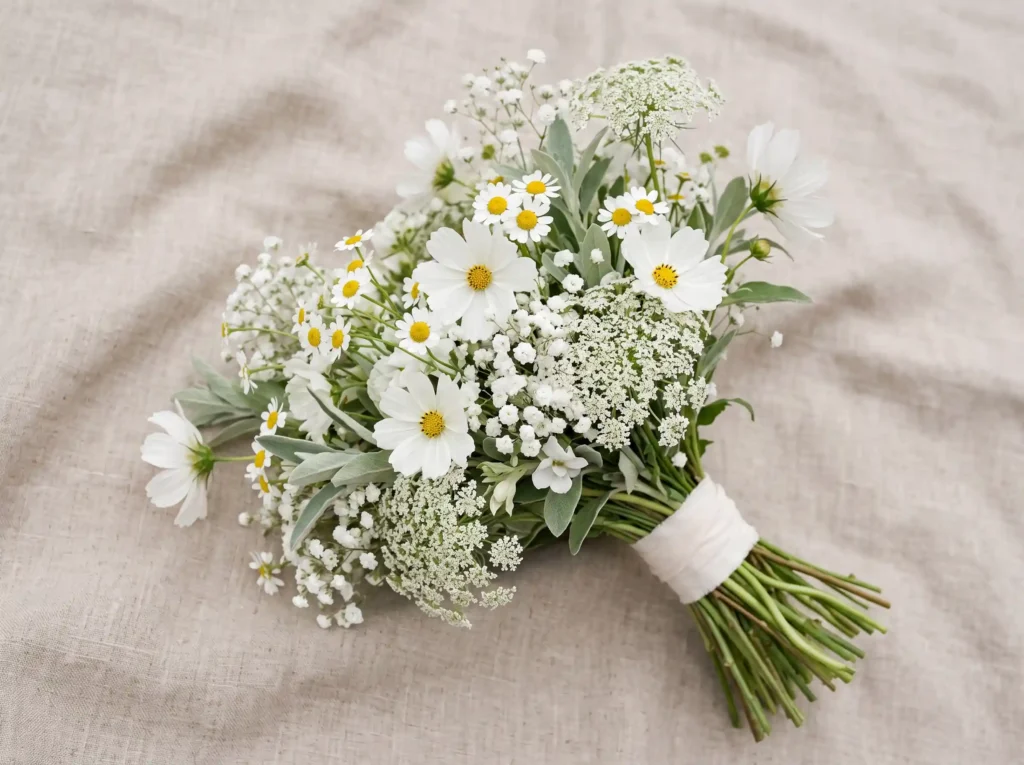
No roses here. No peonies, either. Just field flowers, gathered as if pulled straight from a roadside patch. Cosmos opens wide, thin white petals framing egg-yolk centers. Chamomile echoes nearby, smaller cousin, same daisy logic.
Queen Anne’s lace steals real estate top-right, its flat umbrella clusters made of dozens of tiny blossoms — a wildflower staple, technically a weed, yet elegant enough for aisles. Baby’s breath fills negative space, cheap and airy, doing quiet work most bouquets rely on. Dusty miller leaves, silvery and soft-fuzzed, cool down the greenery.
Muslin wrap, unfussy, matches linen backdrop beneath. Budget-conscious brides take note: this bouquet likely costs a fraction of rose-heavy arrangements. Rustic, unpretentious, genuinely meadow-grown.
5. Champagne Peony Whisper
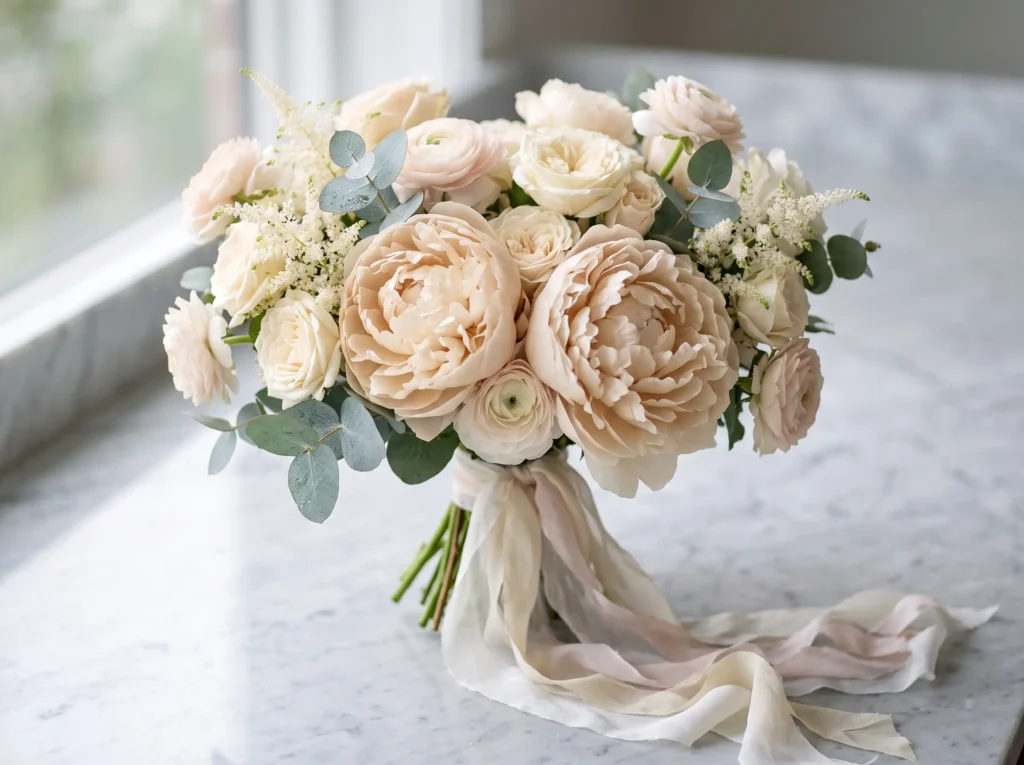
Tonal restraint, executed beautifully. Palette stays within one narrow band — champagne, ivory, blush — nothing competing for attention. Two oversized peonies command center, petals stacked in dozens, ruffled like crushed silk. Old-world charm, essentially. Peonies carry that fleeting-season reputation, prized precisely because they’re only available briefly each year.
Ranunculus fills gaps below, smaller-scaled but visually rhyming with peony structure. Spray roses cluster densely upper-left, tight buds barely open. Astilbe adds vertical texture, feathery plumes breaking up rounder shapes — subtle, easy to miss, essential nonetheless.
Silk ribbon streams long, pooling on marble below, adding movement to otherwise still composition. Monochrome bouquets like this photograph exceptionally well, a quiet reason planners favor them for editorial shoots.
6. Lavender Morning Garden
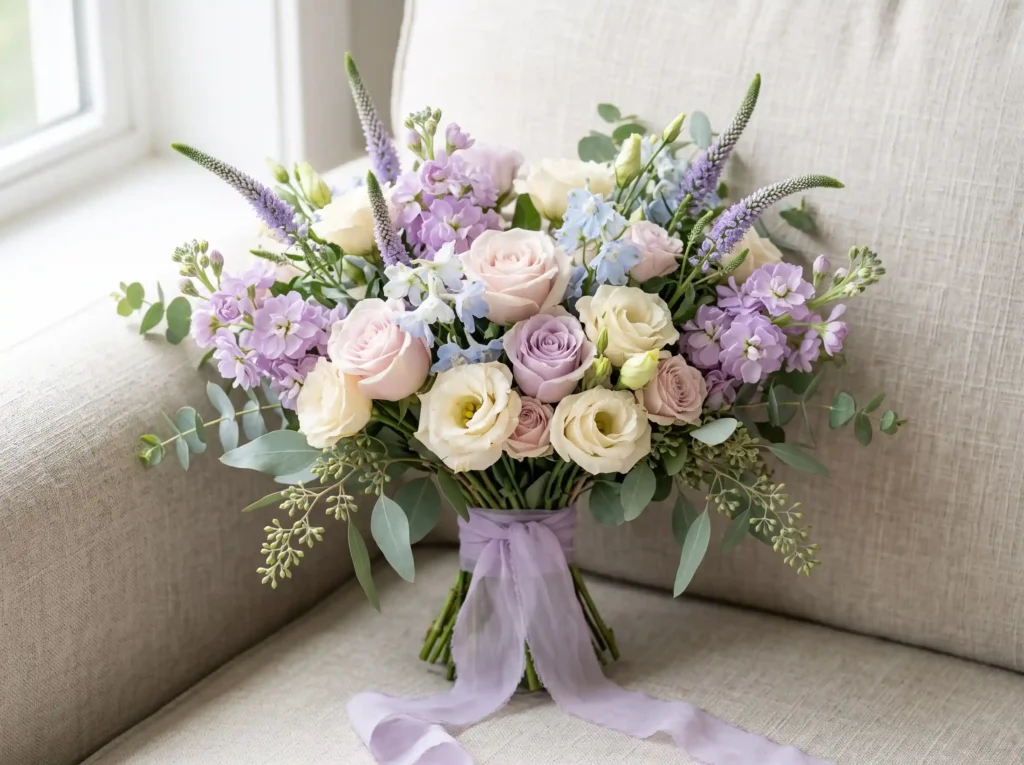
Height, finally. Veronica spikes shoot upward, sharp purple-green punctuation against rounder blooms below. Vertical elements matter in bouquet design — without them, arrangements risk flatness, everything reading same-height, same-shape.
Stock flowers cluster densely, their ruffled purple heads made of dozens of small florets stacked along one stem — an underused variety, honestly, given how much texture it offers per dollar. Lavender roses sit center, unusual tint, cooler than typical blush. Ivory lisianthus balances warmth downward, while pale delphinium buds echo veronica’s blue-purple thread throughout.
Sheer lavender ribbon, tied loose, trails onto linen sofa below. Cool tones like this suit spring ceremonies especially, evoking early-morning garden air. Fresh, considered, quietly dramatic.
7. Olive Branch Elegance
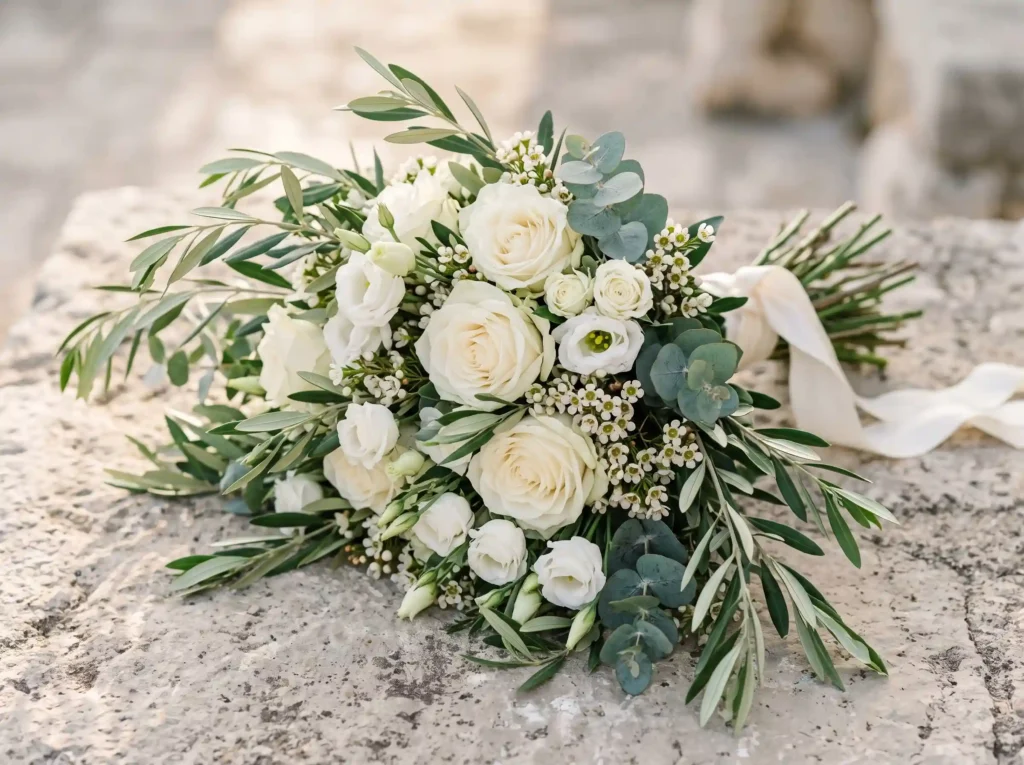
Foliage takes lead role. Long olive branches stretch outward, silvery-green leaves narrow and pointed, instantly evoking sun-baked terraces of Puglia or Provence. Symbolism runs deep, too — olive branch, historically, signals peace, an apt undertone for vows exchanged nearby.
Ivory roses cluster mid-bouquet, classic and unfussy. White lisianthus mixes in, ruffled edges softening rose’s smoother form. Wax flower speckles throughout, tiny star-shaped blooms adding texture without stealing focus — a filler flower florists reach for constantly, prized for how long it holds up post-cutting.
Eucalyptus rounds greenery palette, dustier blue-green against olive’s yellow-green. Stone backdrop, weathered and pale, completes Mediterranean mood entirely. Understated, sun-warmed, quietly romantic.
8. Sunset Apricot Charm
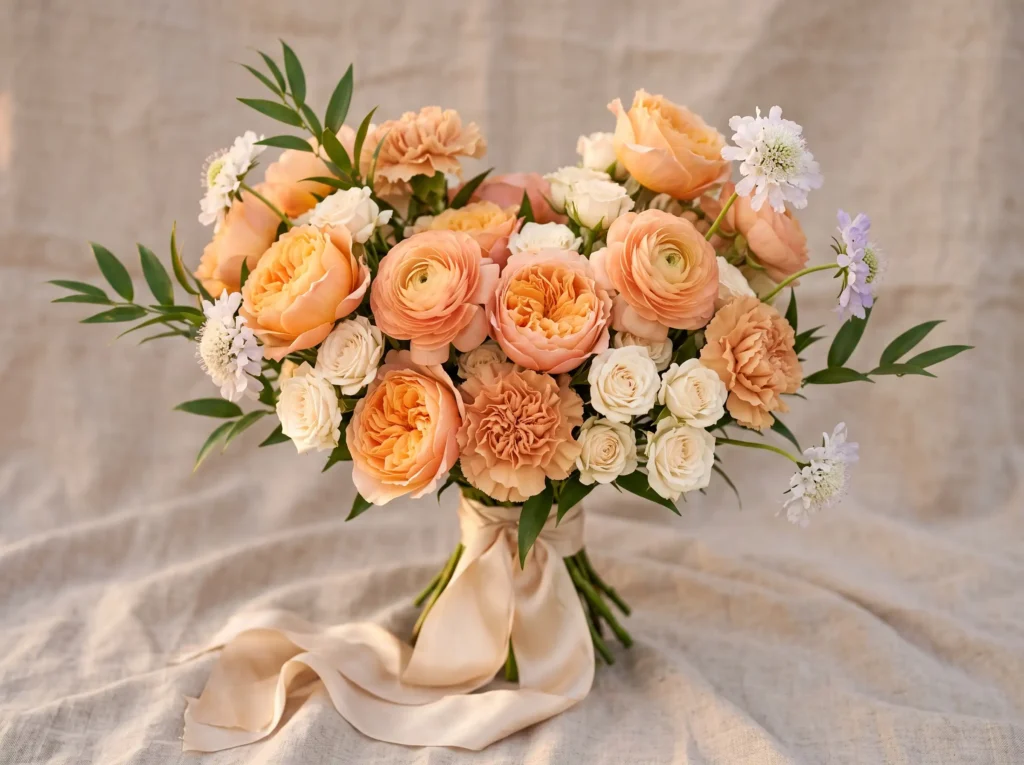
Carnations, unapologetically. Long dismissed as filler, ruffled apricot carnations here hold real weight, their crimped petals adding texture cheaper varieties often lack. Smart choice, honestly — carnations run a fraction of rose cost yet last far longer post-cutting, ideal for stretching flower budgets without visual compromise.
Ranunculus punctuates center, layered petals swirling tight, warm orange deepening toward core. Peachy garden roses echo similar warmth above. Spray roses, cream and small-scaled, cool things down near base.
Scabiosa flowers drift outward on thin stems, lavender and white, adding whimsical movement beyond bouquet’s rounded silhouette. Champagne satin ribbon ties everything together. Sunset palette, budget-smart execution — proof affordable needn’t mean plain.
9. Blue Mist Elegance
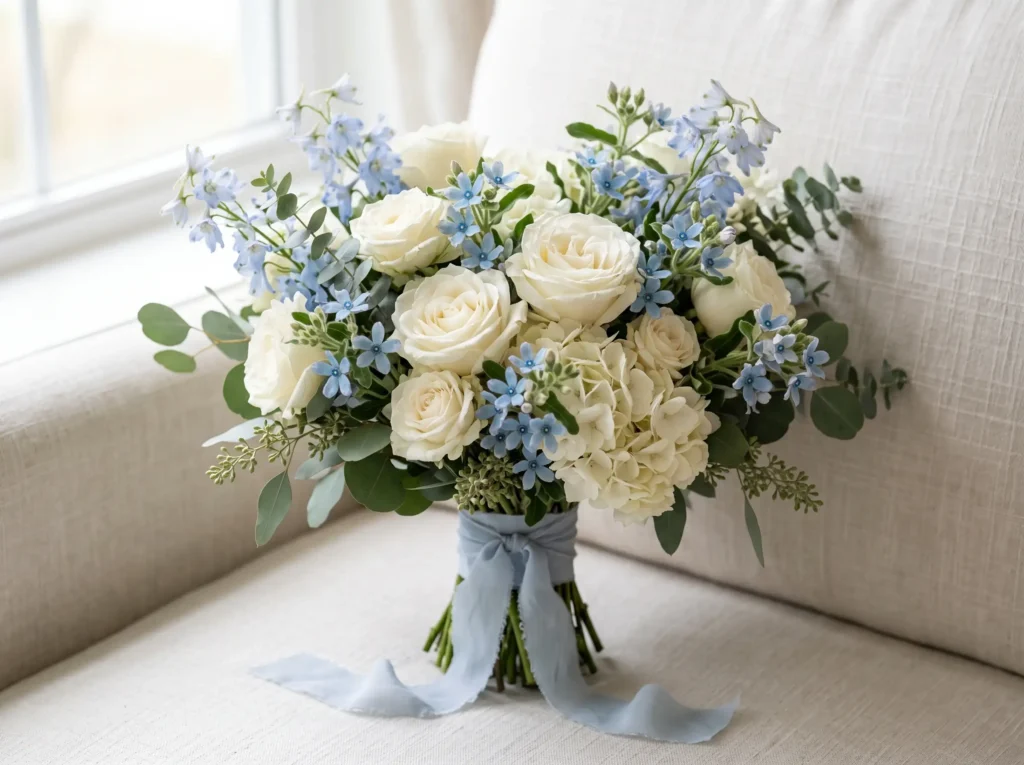
Tradition, reimagined. Rather than tucking blue fabric under a garter, this bouquet builds it right into the blooms — oxypetalum stars scattered throughout, five-petaled, powder-blue, each with a tiny navy center. Clever nod to old wedding rhyme, worn visibly instead of hidden.
Ivory roses form solid base, tight and classic. Hydrangea mounds low, dense clusters mimicking cloud cover — genuinely one of the best value flowers per stem, single head filling space many small blooms couldn’t match. Delphinium spikes climb tall behind, periwinkle against cream, adding height without disrupting palette.
Dusty blue ribbon, frayed edges, pools below on linen sofa. Cool, airy, quietly symbolic — romance grounded in small tradition.
10. Cottage Rose Gathering
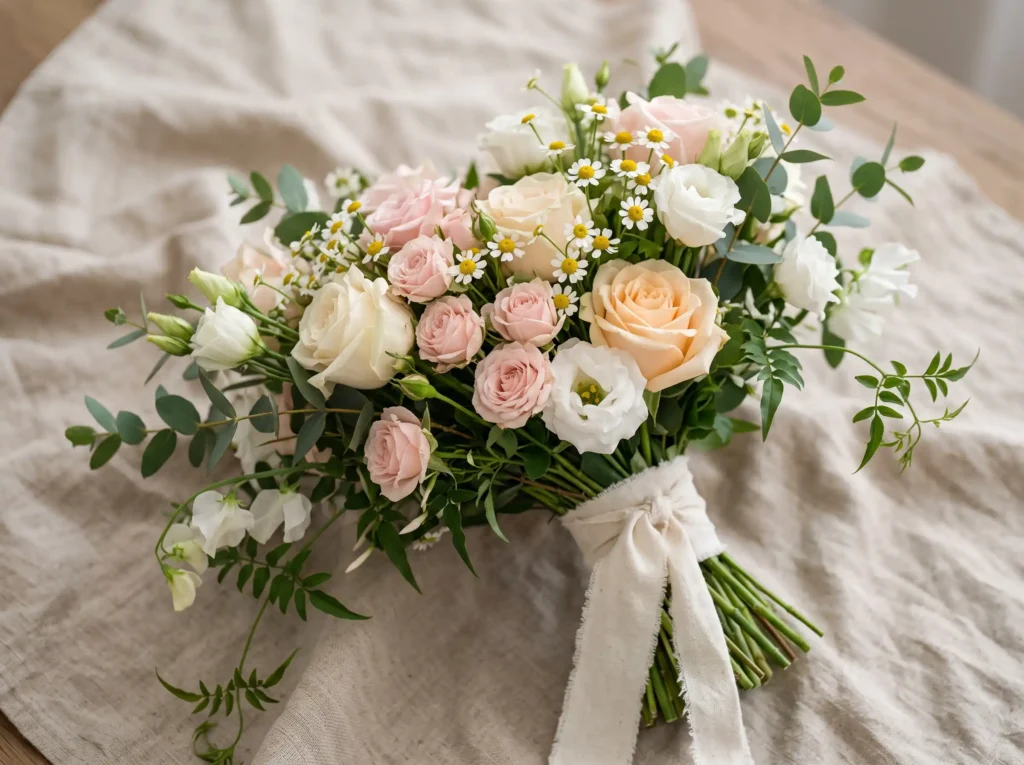
Chamomile does something clever. Scattered loose among roses, its tiny daisy faces trick the eye into believing bouquet grew this way naturally, gathered rather than assembled by trained hands. Cottage-garden floristry thrives on exactly that illusion.
Roses vary in shade deliberately — pale peach, blush pink, soft cream, all sitting side by side rather than matching precisely. Variation reads as authentic, echoing mixed borders found in real English gardens. Sweet pea trails bottom-left, ruffled petals and delicate scent, historically a Victorian garden favorite. White lisianthus rounds shapes out, breaking rose monotony.
Frayed muslin ribbon reinforces handmade feel. Nothing overworked here. Wooden table beneath adds warmth, grounding whole composition in genuine, unpolished ease.
11. Snowy Hydrangea Harmony
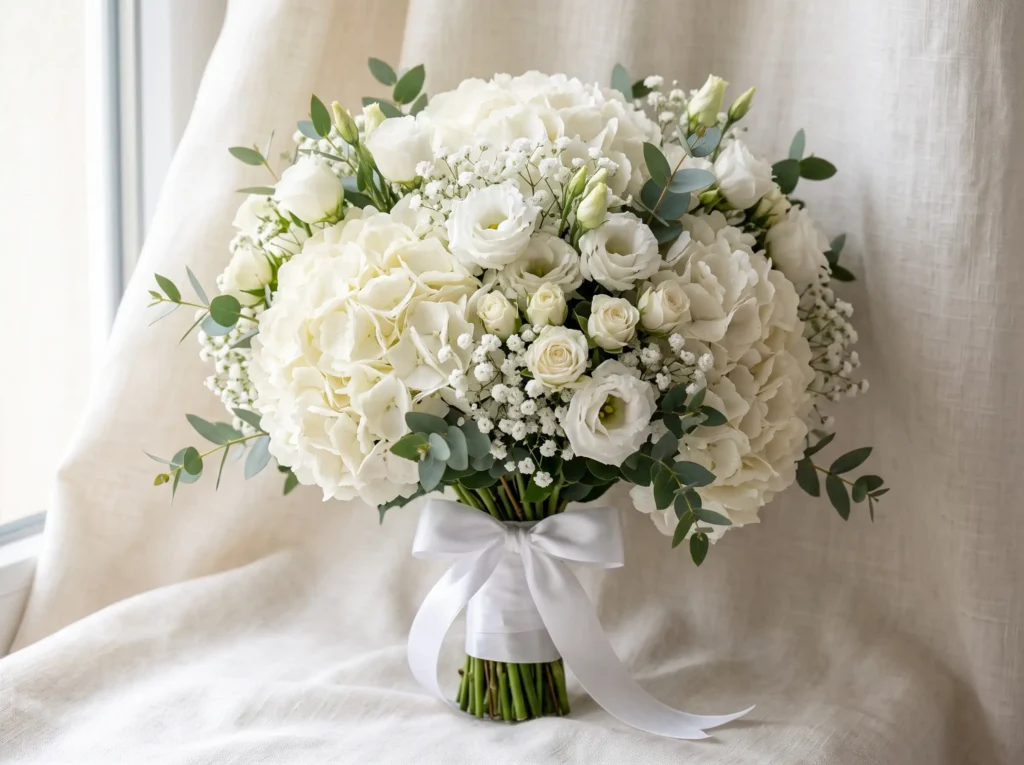
Volume, maximized. Hydrangea heads dominate here, two large mounds forming bouquet’s base, each single stem carrying dozens of small florets fused into one dense bloom. Value-wise, nothing rivals it — florists lean on hydrangea constantly when budget needs stretching without sacrificing size.
Spray roses nestle between, smaller-scaled, softening hydrangea’s papery texture. White lisianthus opens wide near center, ruffled petals catching light differently than surrounding blooms. Gypsophila threads throughout — baby’s breath, technically, though modern arrangements use it far more purposefully than decades past, no longer just filler but genuine texture-builder.
Wide satin ribbon, tied in generous bow, reads formal, traditional. Round, symmetrical silhouette suits classic ceremonies best. Pure white, endlessly versatile, bridal in every sense.
12. Dusty Blush Serenity
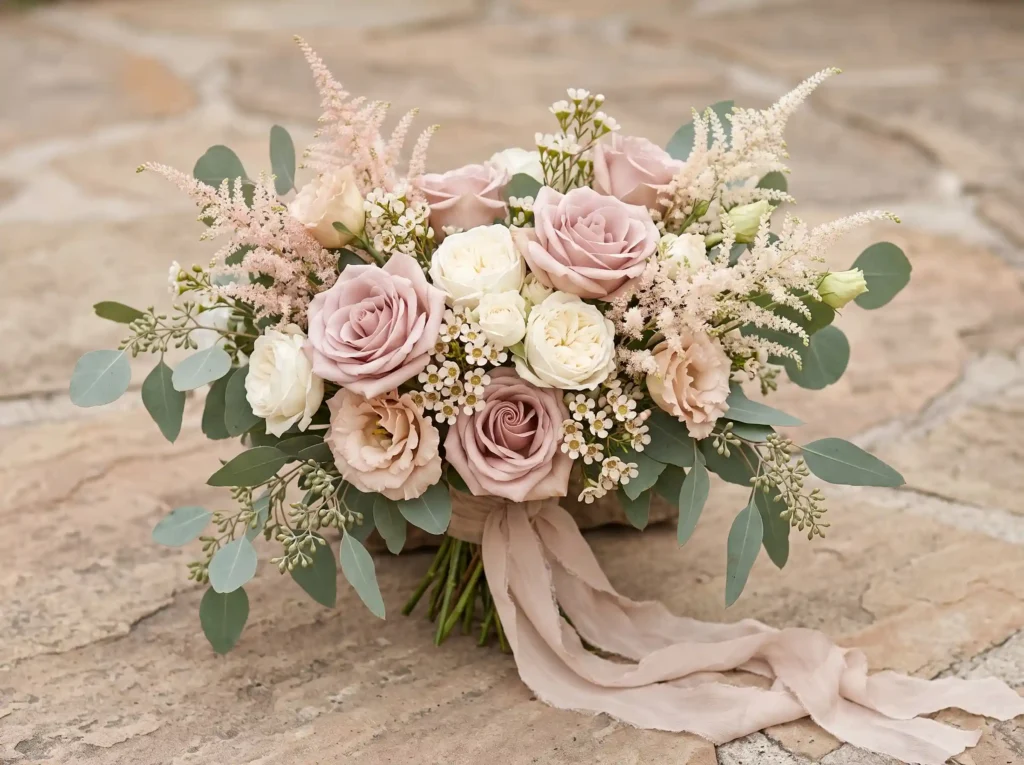
Muted tones, deliberately chosen. Mauve roses here skip standard pink entirely, landing somewhere between dusty rose and antique lavender — a color popular among florists chasing that “vintage photograph” look, slightly desaturated, softer on camera.
Astilbe plumes climb tall from every angle, feathery and pale pink, texture doing what solid blooms can’t. Rare sight in bouquets, honestly, since astilbe bruises easily and demands careful handling. Cream garden roses sit lower, rounder, ruffled centers offering visual rest between astilbe’s spikes. Taupe lisianthus deepens palette further, echoing stone backdrop beneath.
Frayed chiffon ribbon, dusty pink, trails long across weathered rock. Whole composition whispers rather than announces — muted, romantic, texturally rich throughout.
13. Fresh Lemon Garden
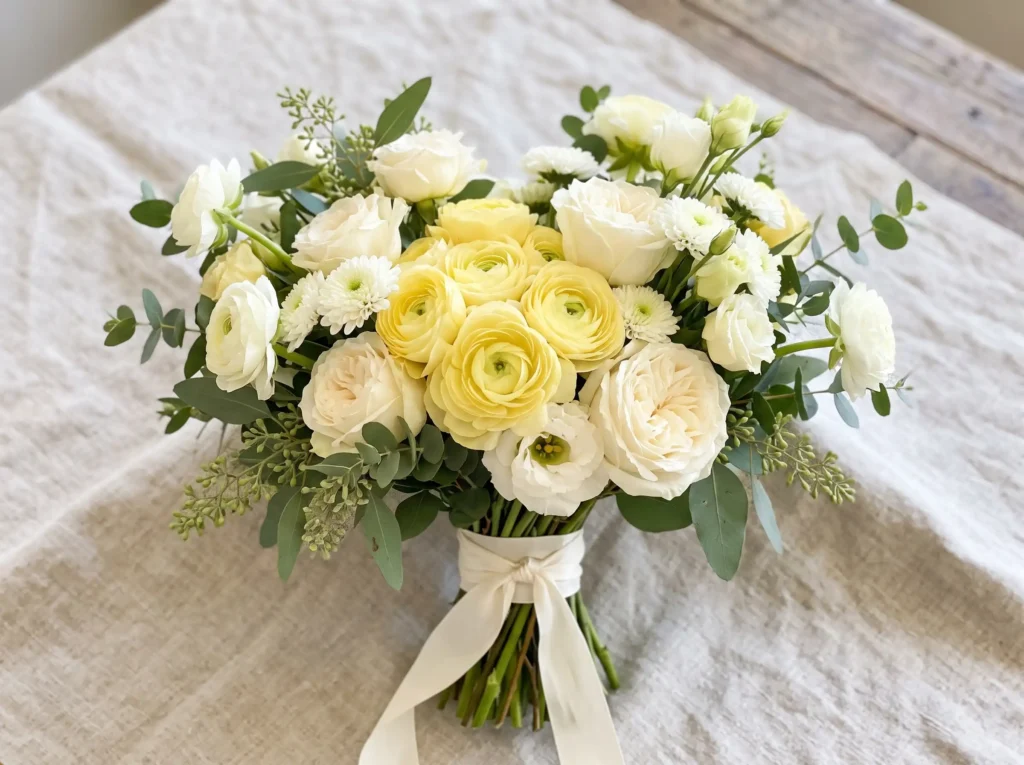
Yellow, tricky color. Too much reads garish; too little loses point entirely. Bouquet threads needle precisely, buttery ranunculus clustered center-mass, surrounded generously by white and cream. Balance, essentially, is whole trick.
Ranunculus layers dozens of tissue-thin petals per bloom, spiraling tight — pale lemon here, softer than typical daffodil-yellow, easier to pair against white without clashing. White mums scatter throughout, cheerful and inexpensive, a color-and-texture workhorse florists reach for often. Cream garden roses anchor lower half, classic ruffled form offsetting mum’s flatter shape.
Eucalyptus, seeded variety, adds berry-like texture along stems. Ivory ribbon, simply tied, matches linen beneath. Cheerful without veering saccharine — yellow done thoughtfully, genuinely spring-appropriate.
14. Whispering Orchid Blend
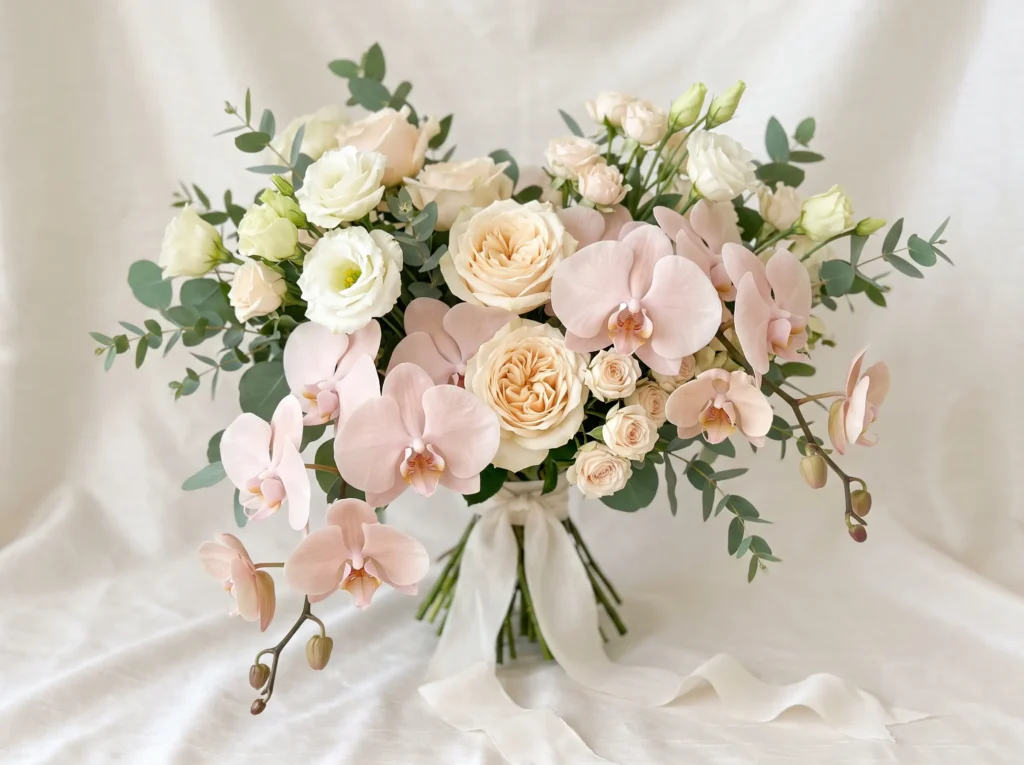
Restraint pays off. Where lesser bouquets overcrowd, this one leans on phalaenopsis orchids as focal statement — arching stems, wing-shaped petals, blush-mauve tone reading almost hand-painted. Orchids carry old-world exoticism, once reserved for royalty, now signaling refined taste at weddings favoring drama over density.
Cream garden roses fill gaps modestly, ruffled centers keeping composition grounded. White lisianthus edges upper corners, cooler tone balancing orchid’s warmth. Spray roses, tiny-scaled, thread through as connective tissue between larger blooms.
Notice restraint in bloom count. Fewer varieties, more impact — quality over quantity, essentially. Long trailing orchid stems escape bouquet’s main mass, adding movement rarely achieved with rounder flowers. Editorial elegance, minimal fuss.
15. Wildflower Breeze
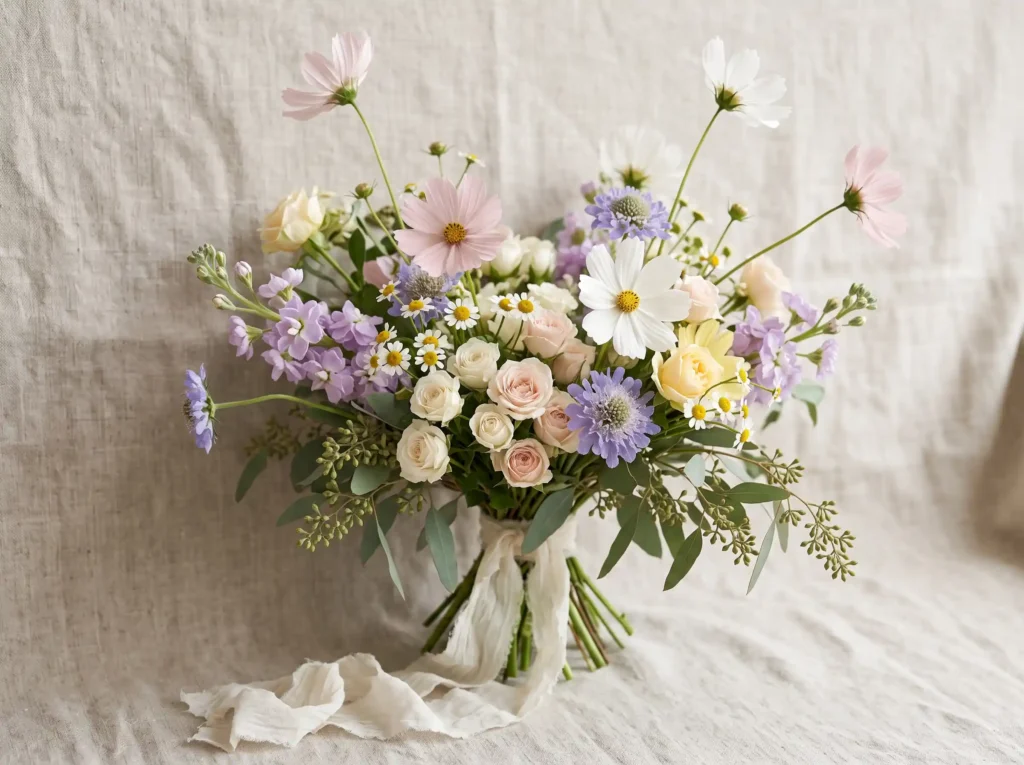
Movement, actual movement. Cosmos flowers shoot up on wiry stems, well above bouquet’s main body, swaying independently — a technique florists call “movement” or “airiness,” deliberately breaking rounded silhouette convention. Pink and white cosmos catch light differently depending on angle, petals thin as tissue.
Color palette refuses single-note discipline. Lavender stock, buttery ranunculus, blush spray roses, purple scabiosa — four, five hues coexisting without clashing, unified by consistently pastel saturation. Chamomile scatters low, grounding taller blooms. Thistle-like scabiosa centers add unexpected texture, spiky where everything else stays soft.
Cheesecloth ribbon, loosely knotted, reinforces relaxed mood. Result feels gathered mid-walk through summer field. Genuinely joyful, unbothered by symmetry.
16. Pearl White Elegance
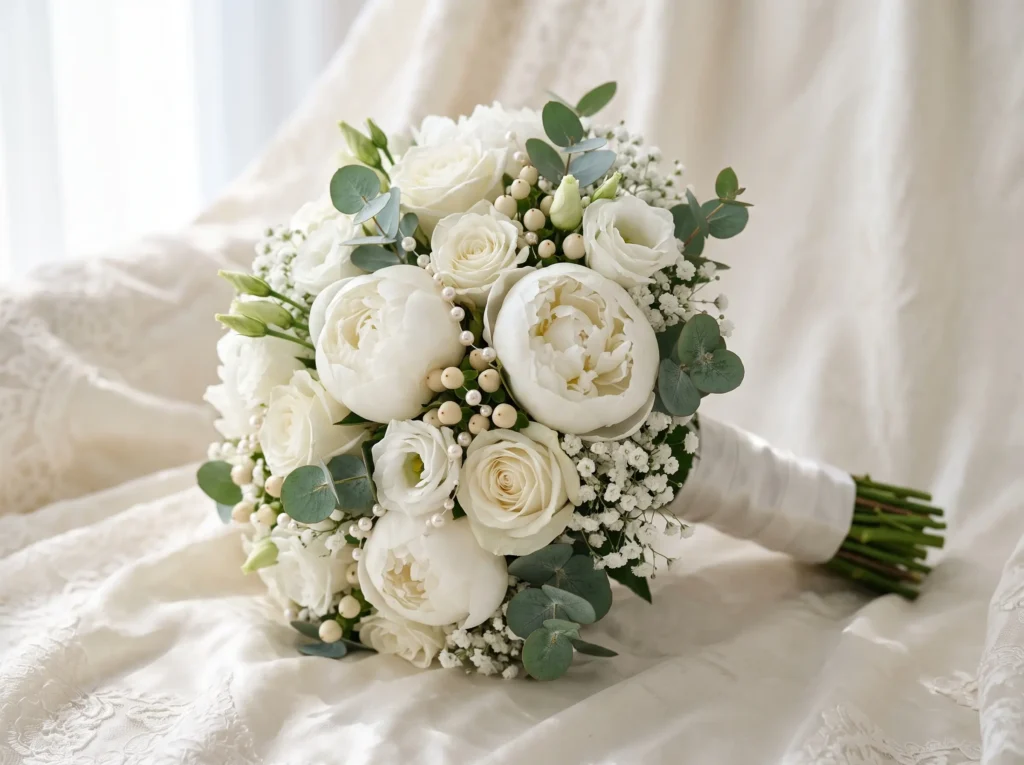
Pearls, literally woven in. Strand loops between petals mid-bouquet, small beads catching light exactly like flowers around them. Rare technique, this — requires steady hands, careful placement, keeping strand secure without crushing surrounding blooms. Worth effort, clearly.
Peonies claim visual weight, two oversized blooms center-stage, densely ruffled. White roses fill remaining space, classic and dependable, joined by lisianthus buds still tightly closed. Cream berries scatter near pearls, mimicking bead shape almost exactly — clever repetition, texture echoing embellishment rather than competing against it.
Baby’s breath clouds lower half, soft and unobtrusive. Lace gown beneath ties whole scene together visually. Bridal, formal, deliberately ornamental — pearls elevate simple white bouquet into heirloom territory.
17. Romantic Mauve Whisper
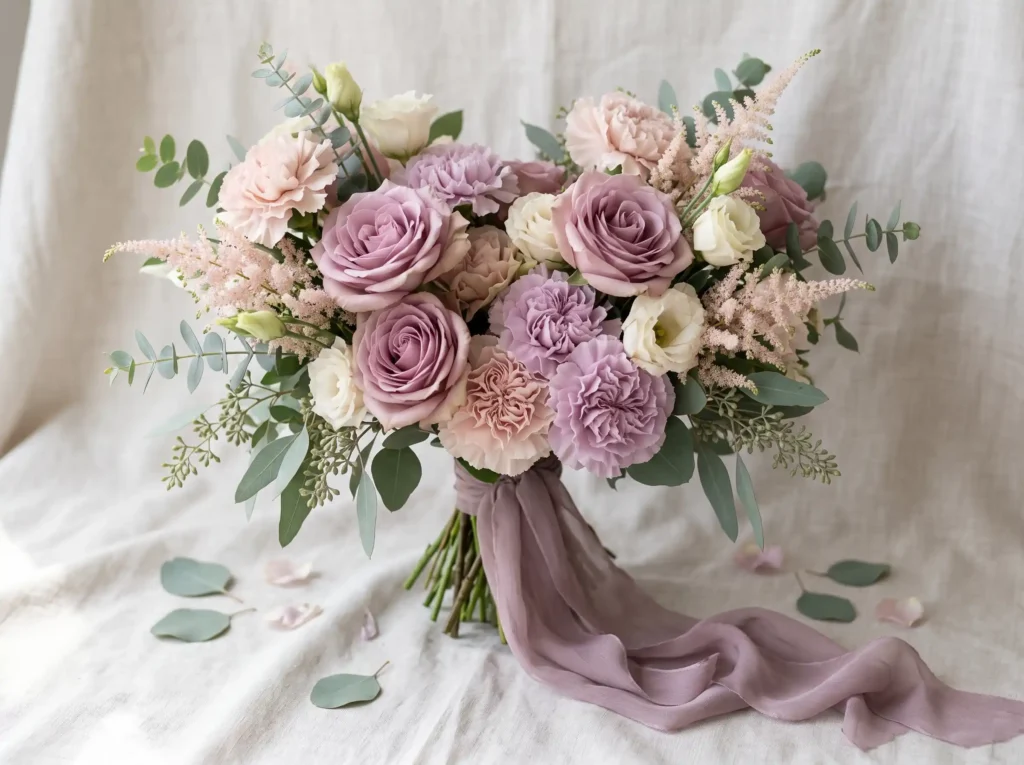
Carnations again, differently deployed. Where sunset bouquet used peachy tones, mauve version leans cooler — dusty purple carnations ruffling densely, proving variety’s range extends well past grocery-store pink. Underrated flower, frankly, given crimped texture rivals pricier blooms at fraction of cost.
Mauve roses repeat that antique-lavender shade, swirling tightly beside carnations, nearly indistinguishable at quick glance except for smoother petal edges. Cream lisianthus interrupts purple dominance, offering visual pause. Astilbe plumes rise soft and feathery, same technique seen in cooler dusty-pink cousin bouquet, though here paired against deeper mauve rather than blush.
Scattered petals and loose eucalyptus leaves dress surrounding linen — styling choice suggesting bouquet mid-arrangement, caught candidly. Silk ribbon pools generously. Moody, romantic, undeniably photogenic.
18. Sage & Cream Botanicals
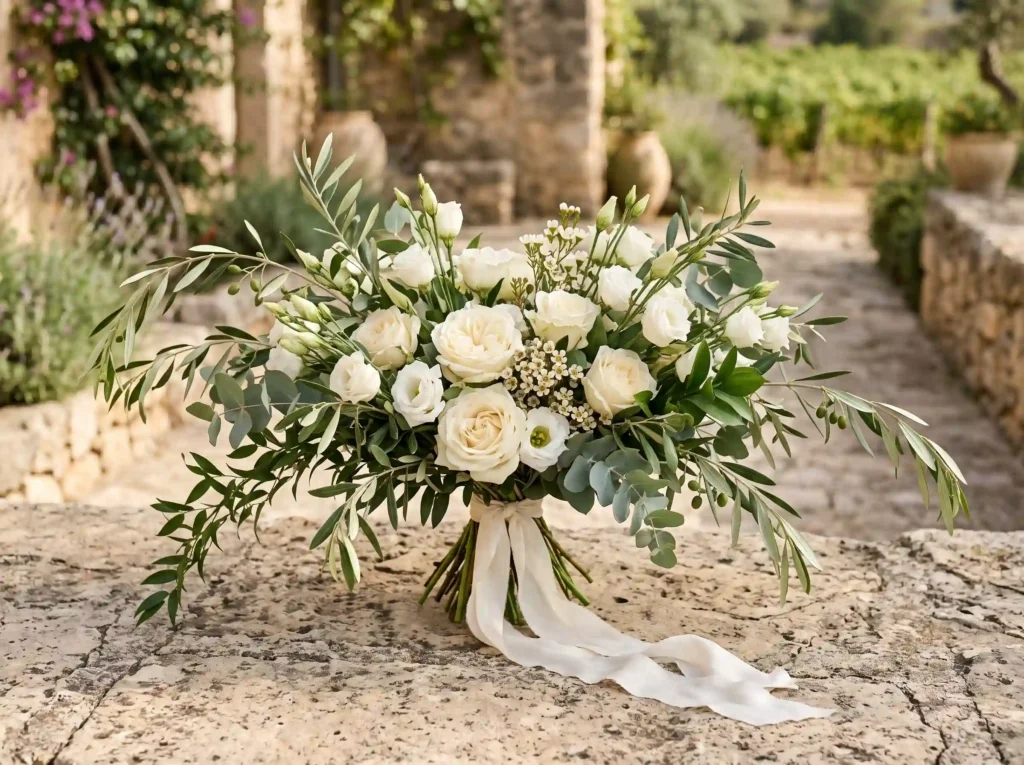
Foliage stretches nearly a full arm’s span, olive branches reaching left and right in dramatic asymmetry. Setting explains choice entirely — stone courtyard, distant vineyard rows, this bouquet belongs precisely where it sits, styled for exactly this Mediterranean backdrop.
Cream roses hold center densely, unfussy and classic. White lisianthus punctuates upward on longer stems, buds still closed at tips, adding vertical lift among horizontal olive sprays. Wax flower speckles small and unobtrusive, familiar workhorse filler doing quiet duty once more.
Eucalyptus mixes into olive foliage, subtle color variance between two greens keeping composition from reading flat. Frayed ivory ribbon trails onto weathered stone. Landscape-driven florals, essentially — bouquet designed to converse with surroundings, not overpower them.
19. Sweet Blush Harmony
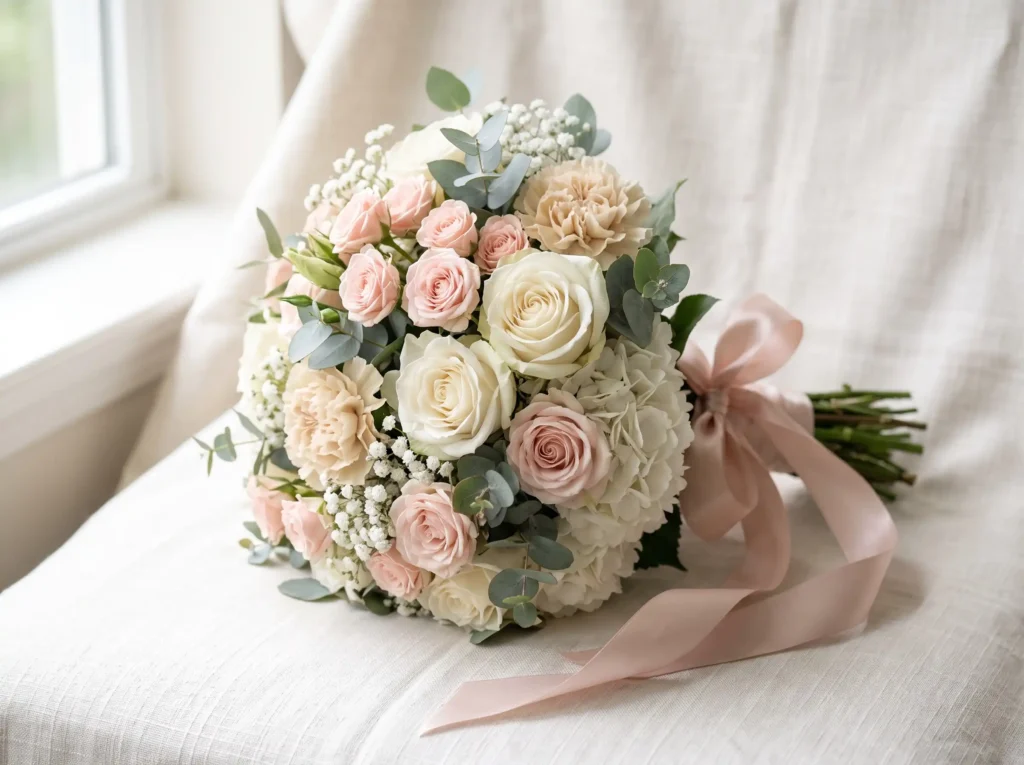
Symmetry, near perfect. Sphere-shaped silhouette, dense on every side, represents most traditional bouquet form in wedding floristry — safe choice, timeless, easy for any florist to replicate reliably. Nothing experimental here, and that’s precisely appeal.
Ivory roses alternate with blush pink, colors close enough in family to blend seamlessly rather than contrast sharply. Carnations tuck in in cream, ruffled texture breaking rose repetition. Hydrangea, once more, bulks volume affordably at base. Baby’s breath threads small white clusters throughout, filling every visible gap.
Satin ribbon, generously bowed, cascades in soft blush folds below. Sunlit curtain backdrop flatters pastel palette entirely. Reliable, romantic, exactly what most brides picture first when word “bouquet” comes to mind.
final thoughts
The best wedding bouquets aren’t always the biggest or the most expensive. These 19 simple wedding flower ideas highlight how affordable blooms, graceful greenery, flowing ribbons, and timeless floral combinations can feel just as refined as luxury designs. Whether your style leans classic, rustic, modern, or garden-inspired, there’s plenty of inspiration to create a bouquet that’s both beautiful and budget-friendly.